

Himiway Cruiser eBike Review: Is It Worth It?
Himiway Cruiser eBike Review: Is This Fat-Tire E-Bike Worth Buying?
The Himiway Cruiser is built around a simple idea: combine a comfortable everyday riding position with fat tires, a large battery and enough motor power for hills, gravel, commuting and recreational riding.

Our Featured Pick: Himiway Cruiser D3
Himiway D3 Cruiser
The Cruiser is the model to consider if your priority is a comfortable, stable fat-tire e-bike with enough battery capacity for longer recreational rides and enough motor output for hills.
- 750W brushless geared hub motor
- 48V 15Ah Samsung/LG battery
- 720Wh battery capacity
- 35–60 mile official range estimate
- 26×4-inch fat tires
- 95mm-travel front suspension fork
- Shimano Altus 7-speed drivetrain
- 180mm mechanical disc brakes
- Half-twist throttle
- 350-lb maximum system weight
- Approximately 72 lb
Which Himiway Cruiser Alternative Should You Consider?

Himiway Cruiser
Best if you want the classic Himiway fat-tire cruiser experience with a large battery and relaxed handling.
- 750W motor
- 720Wh battery
- 26×4 fat tires
- 350-lb maximum system weight
- 7-speed Shimano drivetrain
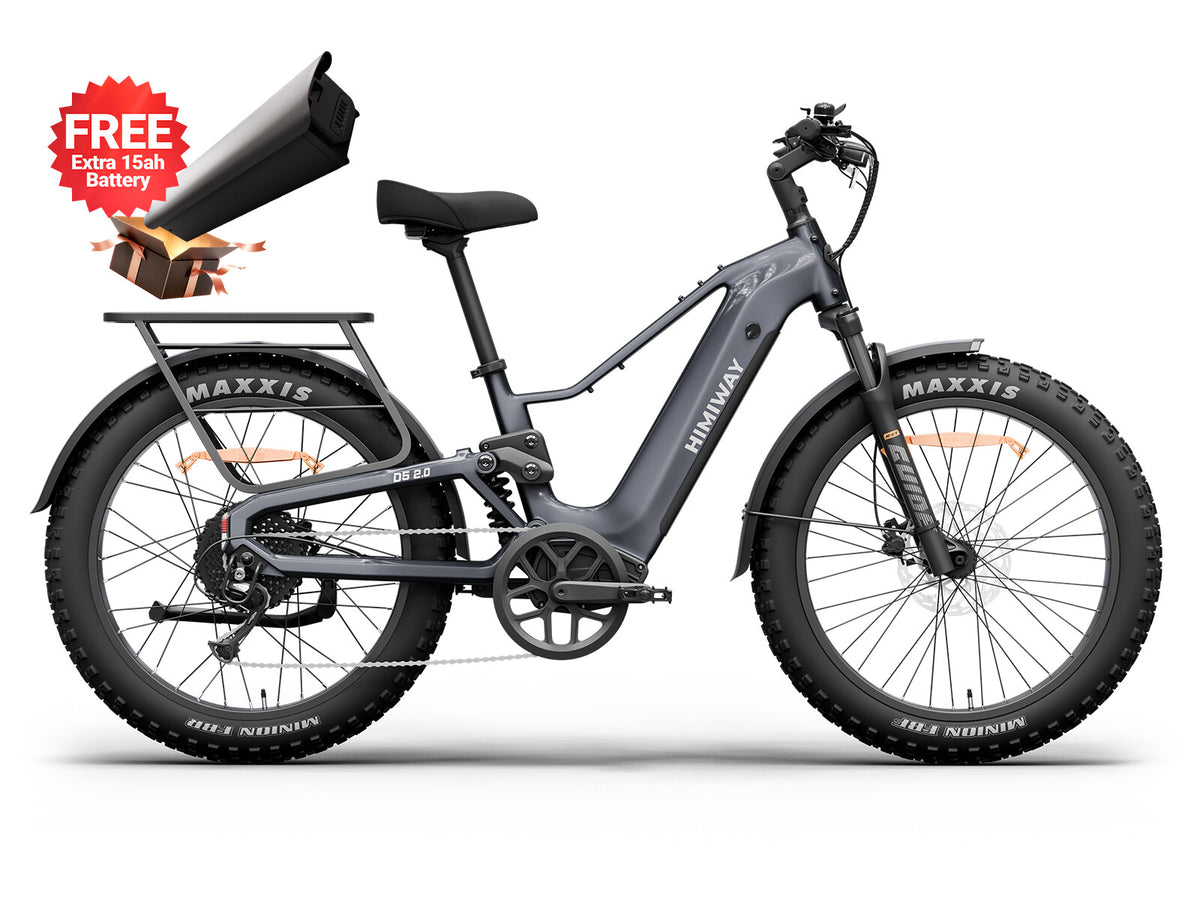
Himiway D5 2.0
A newer full-suspension option for shoppers who want to move beyond the traditional Cruiser platform.
- 750W / 90Nm geared hub motor
- Full suspension
- Torque/cadence sensor options
- Modern integrated lighting
- Designed for comfort and mixed terrain
Himiway Cruiser eBike: Quick Answer
Is the Himiway Cruiser a good e-bike? Yes. The Cruiser is especially attractive if you want comfort, stability, fat tires and a large battery rather than an ultra-light performance e-bike.
- Strong 750W geared hub motor
- 720Wh Samsung/LG battery
- Up to 60 miles claimed range depending on conditions
- 26×4-inch fat tires
- Front suspension
- 350-lb maximum system weight
- Shimano 7-speed gearing
- Half-twist throttle
Best For
- City cruising
- Commuting
- Gravel roads
- Beach and sandy surfaces where permitted
- Recreational riding
- Larger riders
- Longer weekend rides
- Mixed-terrain use
Not Ideal For
- Carrying upstairs
- Racing
- Technical mountain-bike riding
- People who need an ultra-light e-bike
Himiway Cruiser Specifications
The following table summarizes the specifications Himiway currently publishes for the D3 Cruiser. Regional configurations can differ, so verify the exact model before purchasing.
| Specification | Himiway Cruiser D3 |
|---|---|
| Motor | 750W brushless geared hub |
| Peak motor output | Up to 1200W listed |
| Maximum torque | 80Nm |
| Battery | 48V 15Ah Samsung/LG |
| Battery capacity | 720Wh |
| Range | 35–60 miles |
| Wheel size | 26 inches |
| Tire size | 26×4 inches |
| Front suspension | 95mm-travel fork listed |
| Brakes | Tektro Aries mechanical disc |
| Brake rotors | 180mm front / rear |
| Gearing | Shimano Altus 7-speed |
| Throttle | Half-twist throttle |
| Bike weight | Approximately 72 lb |
| Maximum system weight | 350 lb |
| Recommended rider height | 5'3"–6'5" |
| Frame | 6061 aluminum |
Himiway Cruiser eBike Real Product Images
These images come from Himiway's official Cruiser product material and show how the bike looks in real riding environments as well as its complete bicycle profile.


Himiway Cruiser eBike Review
The Himiway Cruiser is one of those electric bikes that makes more sense when you look beyond the headline motor number. It combines a relatively large 720Wh battery, 26×4-inch fat tires, front suspension, a 7-speed Shimano drivetrain and a frame designed to support a 350-pound maximum system weight.
That combination gives the Cruiser a very specific personality. It is not trying to be a lightweight road e-bike. It is not a competition mountain bike. Instead, it is designed to be a comfortable all-terrain electric bicycle that can handle daily transportation, recreational riding and rougher surfaces.
1. Why the Himiway Cruiser Is Still Interesting
The e-bike market has changed dramatically, but the core advantages of the Cruiser remain relevant. Riders still want a bike that can handle hills without exhausting them, travel farther than a small commuter e-bike and remain stable on imperfect surfaces.
The Cruiser's 26×4-inch tires are especially important here. Four-inch tires provide a large contact patch and significant air volume. That can improve stability and help smooth out small bumps when riding over gravel, dirt, cracked pavement and other uneven surfaces.
2. The 750W Geared Hub Motor
Himiway currently lists a 750W brushless geared hub motor for the Cruiser, with up to 1200W peak output and 80Nm maximum torque in its technical material.
The advantage of a geared hub motor is that it can provide strong assistance while keeping the mechanical system relatively simple. For everyday riders, that means the motor can help when starting, climbing hills and accelerating without requiring the rider to produce all of the effort.
Motor wattage should not be treated as a direct measurement of speed. Controller programming, battery voltage, rider weight, terrain, gearing, aerodynamics and local regulations all influence actual performance.
3. Is the Cruiser Good for Hills?
This is one of the areas where the Cruiser's fat tires, gearing and motor combination become useful. Riders can select an easier gear when climbing and use electric assistance to reduce the effort required.
Heavier riders may particularly appreciate the 350-pound maximum system weight rating, although this number includes the bike and carried equipment and should not be interpreted as a 350-pound recommended rider weight.
Very steep hills will still consume more battery than flat riding. If you live in a mountainous area, battery management becomes much more important.
4. The 720Wh Samsung/LG Battery
Battery capacity is arguably more important to an e-bike owner than motor wattage alone. The Cruiser's 48V 15Ah battery provides 720Wh of energy capacity, which is substantial for a bike in this category.
Himiway lists approximately 35–60 miles of range, with the actual distance affected by rider weight, incline, pedal-assist level and riding conditions.
That distinction is important for buyers. If you use maximum assistance, ride into strong headwinds, carry additional weight and climb frequently, your practical range will generally be lower than the maximum marketing figure.
5. Are 26×4 Fat Tires Worth It?
If you primarily ride smooth roads, narrow commuter tires can be faster and more efficient. But the Himiway Cruiser is not designed around that use case.
Its 26×4 tires are intended to provide additional traction and stability. That makes them useful on gravel, sandier surfaces, packed dirt and poor pavement.
Fat tires also change how the bike feels. The Cruiser tends to feel planted rather than nervous, which can be particularly valuable for newer e-bike riders or anyone who wants a relaxed riding experience.
6. Front Suspension and Ride Comfort
The Cruiser uses a suspension fork with approximately 95mm of travel listed on the current product specification.
Combined with the large-volume tires, the suspension helps reduce the impact of rough surfaces. This does not turn the Cruiser into a technical downhill mountain bike, but it makes a meaningful difference during everyday riding.
7. Shimano 7-Speed Gearing
Electric assistance does not eliminate the value of mechanical gearing. The Shimano Altus 7-speed drivetrain allows the rider to choose a lower gear when climbing and a higher gear when traveling faster on flatter terrain.
This also gives the rider more control over how much effort they contribute. Someone who wants exercise can use lower motor assistance and pedal more. Someone commuting to work may prefer higher assistance.
8. Mechanical Disc Brakes
The Cruiser uses Tektro Aries mechanical disc brakes with 180mm rotors.
Mechanical disc brakes are easy to understand and generally straightforward to maintain. However, riders who regularly descend steep hills or carry heavy loads may prefer the additional modulation and hand feel available from hydraulic brakes on newer premium e-bikes.
9. Is the Himiway Cruiser Good for Commuting?
For many riders, yes. The upright riding position, large battery and wide tires make the Cruiser suitable for commuting on roads, bike paths and mixed urban surfaces where e-bikes are legally permitted.
The main issue is size and weight. At approximately 72 pounds, the Cruiser is considerably heavier than a conventional lightweight bicycle.
If you have a garage or ground-floor storage, that may not matter. If you need to carry the bike up two flights of stairs every evening, it becomes a major consideration.
10. Is It Good for Beach Riding?
Fat tires are commonly associated with beach riding because their larger footprint can be advantageous on certain sandy surfaces. However, riders should follow local rules and avoid damaging sensitive natural areas.
Salt water and sand can also accelerate wear on mechanical components. Cleaning and maintenance become especially important after riding in harsh environments.
11. Is It Good for Larger Riders?
This is one of the strongest Cruiser selling points. Himiway lists a 350-pound maximum system weight and specifically positions the aluminum frame as suitable for larger riders and riders carrying belongings.
Again, system weight means the total of rider, bicycle and cargo. Buyers should calculate the combined load rather than comparing their body weight directly against 350 pounds.
12. Is the Cruiser Comfortable for Seniors?
It can be. The wide tires, suspension and upright geometry can make the bike feel more stable and forgiving than an aggressive road-style e-bike.
However, the 72-pound weight is important. A rider who has difficulty controlling or moving a heavy bicycle should consider a lighter step-through model instead.
13. Cruiser vs Step-Through Cruiser
Himiway also offers a Cruiser Step-Thru configuration. The basic philosophy is similar, but the step-through frame can make mounting and dismounting easier.
If you frequently stop in traffic, have limited hip mobility or simply prefer not to swing a leg over a high top tube, the step-through design deserves serious consideration.
14. How Far Can the Cruiser Actually Travel?
Himiway publishes a 35–60-mile range. Think of this as a range rather than a promise.
A light rider on relatively flat roads using moderate pedal assist may achieve results closer to the upper portion of the range. A heavier rider climbing hills with frequent throttle use will likely see a shorter distance.
Tire pressure also matters. Fat tires are sensitive to pressure changes, and the correct pressure should be selected based on rider weight, surface and manufacturer guidance.
15. Who Should Not Buy the Cruiser?
The Cruiser is not perfect for everyone. If your primary goal is to carry an e-bike onto public transport, place it inside a compact car or lift it upstairs regularly, the 72-pound weight may become frustrating.
Likewise, competitive cyclists may prefer a lighter bicycle with narrower tires.
And riders who specifically want hydraulic brakes should compare newer Himiway models before committing.
Himiway Cruiser Pros and Cons
Pros
- 750W geared hub motor
- 720Wh Samsung/LG battery
- 35–60-mile stated range
- 26×4 fat tires
- 350-lb maximum system weight
- 72-lb bike weight is reasonable for this category
- 95mm-travel front suspension
- Shimano 7-speed drivetrain
- 180mm disc brakes
- Half-twist throttle
- Strong all-terrain versatility
- Comfortable for recreational riding
Cons
- Heavy compared with traditional bicycles
- Mechanical rather than hydraulic brakes
- Fat tires create more rolling resistance
- Not designed for technical downhill riding
- Current D3 listing shows out-of-stock status
- Actual range varies considerably with riding conditions
- Regional specifications may differ
Himiway Cruiser vs Other Himiway E-Bikes
The Cruiser remains a strong choice, but newer Himiway models can offer different advantages. Here's how to think about the lineup.
| Model | Best For | Main Strength | Main Tradeoff | Our Take |
|---|---|---|---|---|
| Himiway Cruiser D3 | Fat-tire cruising | 720Wh battery + 26×4 tires | Older platform / availability | ★★★★★ |
| Himiway D5 2.0 | Modern all-terrain riding | Full suspension + 750W/90Nm | More expensive | ★★★★★ |
| Himiway A7 | Commuting | Full suspension commuter design | Less traditional cruiser feel | ★★★★☆ |
| Himiway D5 Zebra | Range and value | Large 960Wh battery | Different geometry | ★★★★★ |
What Makes the Himiway Cruiser Different?
| Feature | Why It Matters | Cruiser Rating |
|---|---|---|
| Battery | Large enough for longer recreational rides | Excellent |
| Motor | Strong assistance for hills and heavier riders | Excellent |
| Fat tires | Stability and mixed-surface capability | Excellent |
| Suspension | Improves comfort over rough surfaces | Very Good |
| Brakes | Mechanical disc braking | Good |
| Portability | 72-lb bike is difficult to carry | Average |
| Commuting | Comfortable but relatively large | Very Good |
| Off-road | Good for moderate mixed terrain | Excellent |
Himiway Cruiser Motor Watts → Horsepower & Speed Calculator
Use this calculator to visualize how motor wattage translates into mechanical horsepower. The speed output is deliberately an educational estimate, not a manufacturer claim.
Important: actual speed depends on controller settings, battery, gearing, rider weight, terrain, wind, tire pressure and applicable legal restrictions. This calculator is not a speed guarantee.
Himiway Cruiser Buying Guide
Buy the Cruiser If You Want Comfort
The Cruiser is built around comfort more than racing efficiency. The fat tires, suspension fork, upright geometry and large saddle make it attractive for riders who want to spend an hour or more on the bike without adopting an aggressive cycling position.
Buy It If You Ride Mixed Surfaces
If your route includes pavement followed by gravel, dirt or rough recreational paths, the 26×4 tires make the Cruiser more versatile than a narrow-tire commuter.
Buy It If You Need a Higher Load Rating
The 350-pound maximum system weight gives the Cruiser a useful advantage for larger riders or people who regularly carry equipment.
Think Twice If You Need to Carry the Bike
At roughly 72 pounds, this is not a bike most people will enjoy carrying upstairs. Ground-level storage is strongly preferable.
Think Twice If You Want Hydraulic Brakes
The Cruiser uses mechanical disc brakes. They can work well when properly adjusted, but riders specifically seeking hydraulic braking should compare newer models.
Think Twice If You're a Performance Cyclist
The Cruiser's strength is versatility. It is not designed to compete with lightweight road bikes or technical mountain bikes.
Himiway Cruiser Real-World Range Guide
Himiway's published range is approximately 35–60 miles. The number you experience will depend heavily on how you ride.
| Riding Condition | Effect on Range |
|---|---|
| Flat pavement + moderate PAS | Most favorable |
| Heavy throttle use | Higher consumption |
| Frequent hills | Lower range |
| Heavy rider/load | Lower range |
| Strong headwind | Lower range |
| Correct tire pressure | Better efficiency |
| Low assistance + active pedaling | Better efficiency |
Important E-Bike Safety & Legal Note
E-bike laws vary by country, state, province and municipality. Motor classifications, permitted speeds, throttle use, helmet requirements and where electric bikes may be ridden can all differ.
Do not assume that the maximum speed shown in an online specification is automatically legal where you live. Check your local regulations before riding on public roads or paths.
Himiway Cruiser for Daily Transportation
One of the most practical uses for the Cruiser is daily transportation. Instead of treating the e-bike as a weekend toy, riders can use it for errands, commuting, visiting friends and recreational exercise.
The battery capacity is particularly useful here. A commute that would normally require a car can become a predictable electric-bike journey, while the motor assistance helps reduce the physical effort required to arrive at work.
Himiway Cruiser for Exercise
An e-bike does not have to eliminate exercise. Riders can choose lower assistance levels and contribute more of their own effort.
That creates a useful middle ground between a conventional bicycle and a motorcycle. You can work harder when you want exercise and increase assistance when you are tired, climbing or facing strong wind.
Himiway Cruiser for Weekend Riding
This is arguably where the Cruiser's personality makes the most sense. The wide tires and relaxed geometry encourage exploration rather than speed-focused cycling.
A weekend route can include pavement, gravel and compact dirt without requiring a dedicated bicycle for every surface.
Himiway Cruiser for Larger Riders
Larger riders should pay particular attention to the maximum system weight, frame geometry, saddle comfort and motor behavior under load.
The Cruiser's 350-pound system rating makes it worth considering, especially compared with lightweight e-bikes designed around lower payloads.
Is the Himiway Cruiser Still Worth Buying?
The answer depends on price and availability. The basic design remains attractive: 750W motor, 720Wh battery, 26×4 tires, suspension and 350-pound system capacity.
However, Himiway's newer models offer increasingly sophisticated suspension systems, sensors, displays and braking components.
Therefore, the Cruiser makes the most sense when its price is competitive and when you specifically want its classic fat-tire cruiser design.
More Himiway & E-Bike Guides
If you're comparing a high-ticket e-bike, don't make your decision based on one specification. Compare battery size, rider fit, brakes, suspension, weight, range and intended terrain.
Himiway Cruiser eBike FAQ
Is the Himiway Cruiser a good e-bike?
Yes. The Cruiser is particularly good for riders who prioritize comfort, stability, fat tires, battery capacity and mixed-terrain versatility. It is less suitable for people who need an ultra-light or highly portable e-bike.
How powerful is the Himiway Cruiser?
Himiway currently lists a 750W brushless geared hub motor for the D3 Cruiser, with 80Nm maximum torque and up to 1200W peak output in its product information.
How far can the Himiway Cruiser go?
Himiway lists approximately 35–60 miles of range. Actual range depends on rider weight, terrain, assistance level, wind, tire pressure and throttle use.
How big is the Himiway Cruiser battery?
The Cruiser uses a 48V 15Ah Samsung/LG battery, equivalent to approximately 720Wh.
How heavy is the Himiway Cruiser?
Himiway lists the Cruiser at approximately 72 pounds.
What size tires does the Himiway Cruiser have?
The Cruiser uses 26×4-inch fat tires designed to provide additional traction and stability on mixed surfaces.
Is the Himiway Cruiser good for larger riders?
The Cruiser has a maximum system weight rating of 350 pounds, making it worth considering for larger riders and riders who carry additional equipment. Remember that system weight includes the bike and cargo as well as the rider.
Does the Himiway Cruiser have a throttle?
Yes. Himiway lists a half-twist throttle. Local laws determine whether and where throttle-assisted riding is permitted.
Does the Himiway Cruiser have suspension?
Yes. The current D3 specification lists a front suspension fork with approximately 95mm of travel.
Is the Himiway Cruiser currently available?
Himiway's current D3 Cruiser product listing shows the model as out of stock. Availability can change, so buyers should check the official Cruiser collection for current inventory and alternatives.
Ready to Check the Himiway Cruiser?
If you want a comfortable fat-tire e-bike with a 750W geared hub motor, 720Wh battery, 26×4 tires, front suspension and a 350-pound maximum system weight, the Himiway Cruiser deserves a place on your shortlist.
The biggest reason to check availability now is simple: the current D3 listing shows an out-of-stock status, while Himiway's Cruiser collection can change as models and inventory are updated.
Check Himiway Cruiser Availability →Affiliate disclosure: RenovoMotors may earn a commission from qualifying purchases. Our 4.7/5 score is a RenovoMotors editorial rating and is not presented as Himiway's customer rating.