

Himiway E-Bike Review: Best Models Compared
Himiway E-Bike Review & Buying Guide: Which Himiway Electric Bike Is Best?
Looking for the best Himiway e bike? Himiway's lineup now covers everything from comfortable commuter e-bikes and practical cargo bikes to powerful full-suspension fat-tire models and premium 1000W mountain e-bikes. We compare the most interesting models so you can choose based on range, motor power, comfort, payload, terrain and budget.

Himiway D5 2.0
Our featured Himiway e bike is the D5 2.0 because it combines power, comfort and all-terrain capability in a package that sits below Himiway's premium $3,000+ models.
- 750W geared hub motor with 90Nm claimed torque
- Full suspension with 100mm front and 130mm rear travel
- Torque and cadence riding modes
- 3.5-inch full-color Bluetooth display
- 26×4.0 Maxxis fat tires
- Hydraulic disc brakes
- Designed around comfort and high-capacity riding
Promotional prices and availability can change. Check the live Himiway catalog before purchasing.
Why Himiway E-Bikes Are Worth Considering
Himiway has built its e-bike lineup around a simple idea: give riders more capability than a basic city e-bike while keeping the bikes practical enough for everyday use.
That philosophy is visible across the current range. There are fat-tire all-terrain bikes for riders who want stability and traction, full-suspension bikes for comfort, commuter models for paved-road riding, cargo models for utility and premium mid-drive mountain bikes for serious off-road use.
The result is a lineup that can be confusing if you simply look at the product names. A $1,499 Zebra and a $3,999 D7 Pro are both Himiway e-bikes, but they are designed for very different buyers.
That's why this guide focuses on the riding experience rather than simply listing specifications. The right Himiway electric bike depends on where you ride, how much you weigh, whether you carry cargo, how far you want to travel and how important suspension and portability are to you.
Best Himiway E-Bikes at a Glance
These are the Himiway models we would put on a serious buyer's shortlist. Each serves a different purpose, so the "best" model depends on your use case.
Himiway D5 2.0
Full-suspension comfort with 750W power and 90Nm claimed torque.
- 750W / 90Nm
- Full suspension
- Torque + cadence
- Maxxis 26×4 tires
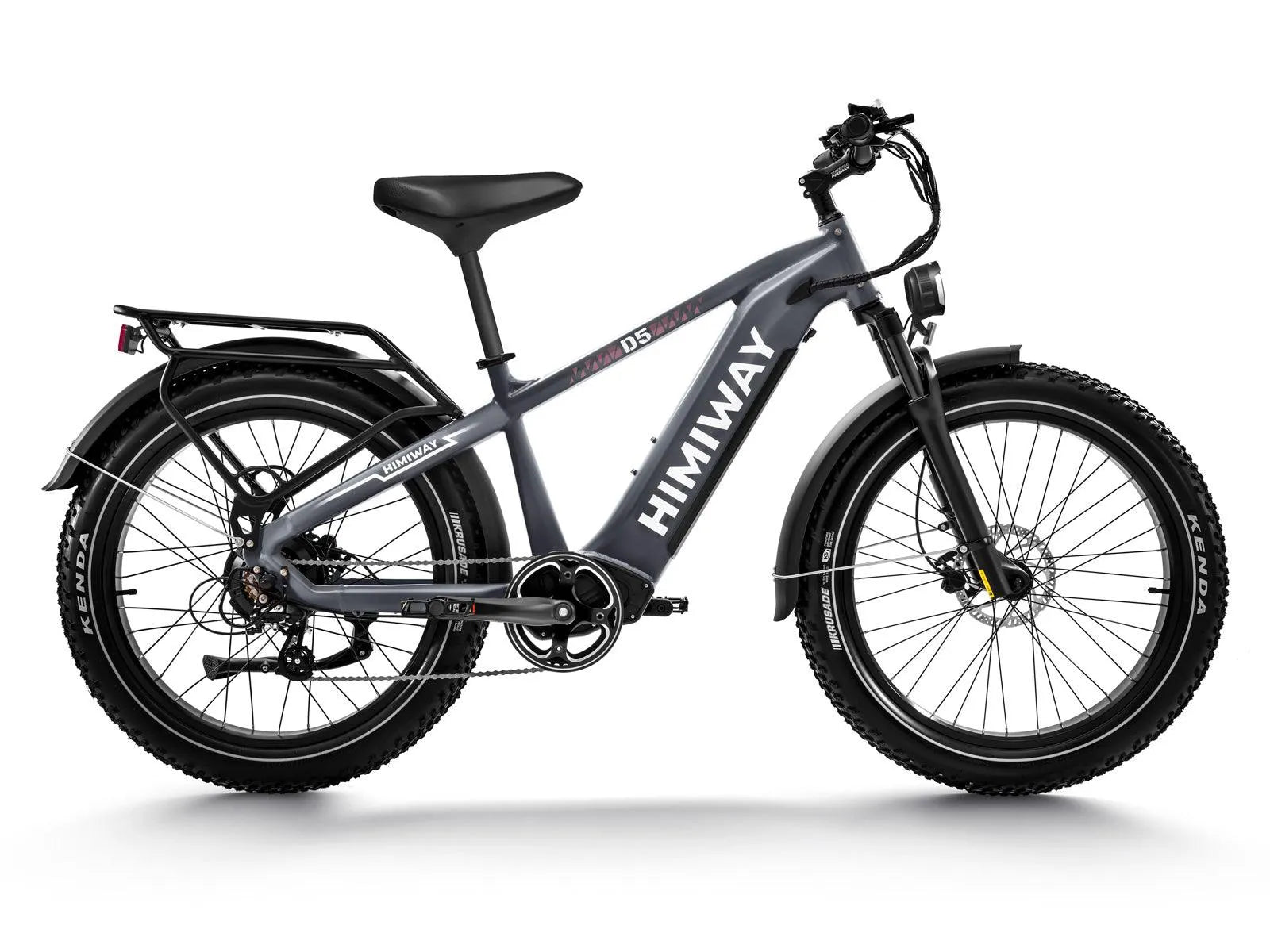
Himiway Zebra
A strong value pick with 750W power, 960Wh battery and high payload.
- 750W motor
- 960Wh battery
- Up to 80 miles claimed
- 400-lb payload

Himiway A7
A full-suspension commuter platform focused on comfort and daily riding.
- Full suspension
- Torque/cadence modes
- Up to 70-mile listed range
- Comfortable geometry

Himiway C3 Cargo
Designed for riders who want to carry people, gear or everyday cargo.
- 750W motor
- 960Wh battery
- Up to 80 miles claimed
- Up to 440-lb listed payload

Himiway D7 Pro
The high-ticket choice for serious off-road riding and maximum motor torque.
- 1000W mid-drive
- 160Nm claimed torque
- 960Wh battery
- 28 MPH listed top speed

Himiway D5 Pro
A mid-drive alternative for riders who prefer a different power-delivery system.
- 500W mid-drive
- 960Wh battery
- 80-mile claimed max range
- 20+ MPH listed speed
Which Himiway E-Bike Should You Buy?
Choose the D5 2.0 if...
- You want full suspension.
- You want strong 750W-class power.
- You ride rough pavement, gravel or mixed terrain.
- You want torque and cadence sensor flexibility.
- Comfort matters more than minimum weight.
Choose the Zebra if...
- You want maximum battery capacity around the lower price tier.
- You want 26×4 fat tires.
- You want a 400-lb payload rating.
- You want a simple all-terrain platform.
Choose the A7 if...
- Most of your riding is commuting.
- Comfort and road usability are priorities.
- You want full suspension without going to the D7 Pro.
Choose the D7 Pro if...
- You want premium off-road performance.
- You want a 1000W mid-drive.
- You value 160Nm claimed torque.
- Your budget is around $4,000.
Himiway E-Bike Comparison Table
This table gives you a fast way to identify which Himiway electric bike matches your intended riding style.
| Model | Motor | Battery | Claimed Range | Best For | Price Shown |
|---|---|---|---|---|---|
| D5 2.0 | 750W / 90Nm | 15Ah | Up to 70 mi PAS | All-terrain comfort | $1,999 |
| D5 / Zebra | 750W | 960Wh | Up to 80 mi | Value + range | $1,499 |
| A7 | Commuter platform | Varies | Up to 70 mi | Commuting | $1,999 |
| C3 Cargo | 750W | 960Wh | Up to 80 mi | Cargo / utility | $1,499 |
| D5 Pro | 500W mid-drive | 960Wh | Up to 80 mi | Mid-drive riding | $1,899 |
| D7 Pro | 1000W mid-drive | 960Wh | Up to 80 mi | Serious off-road | $3,999 |
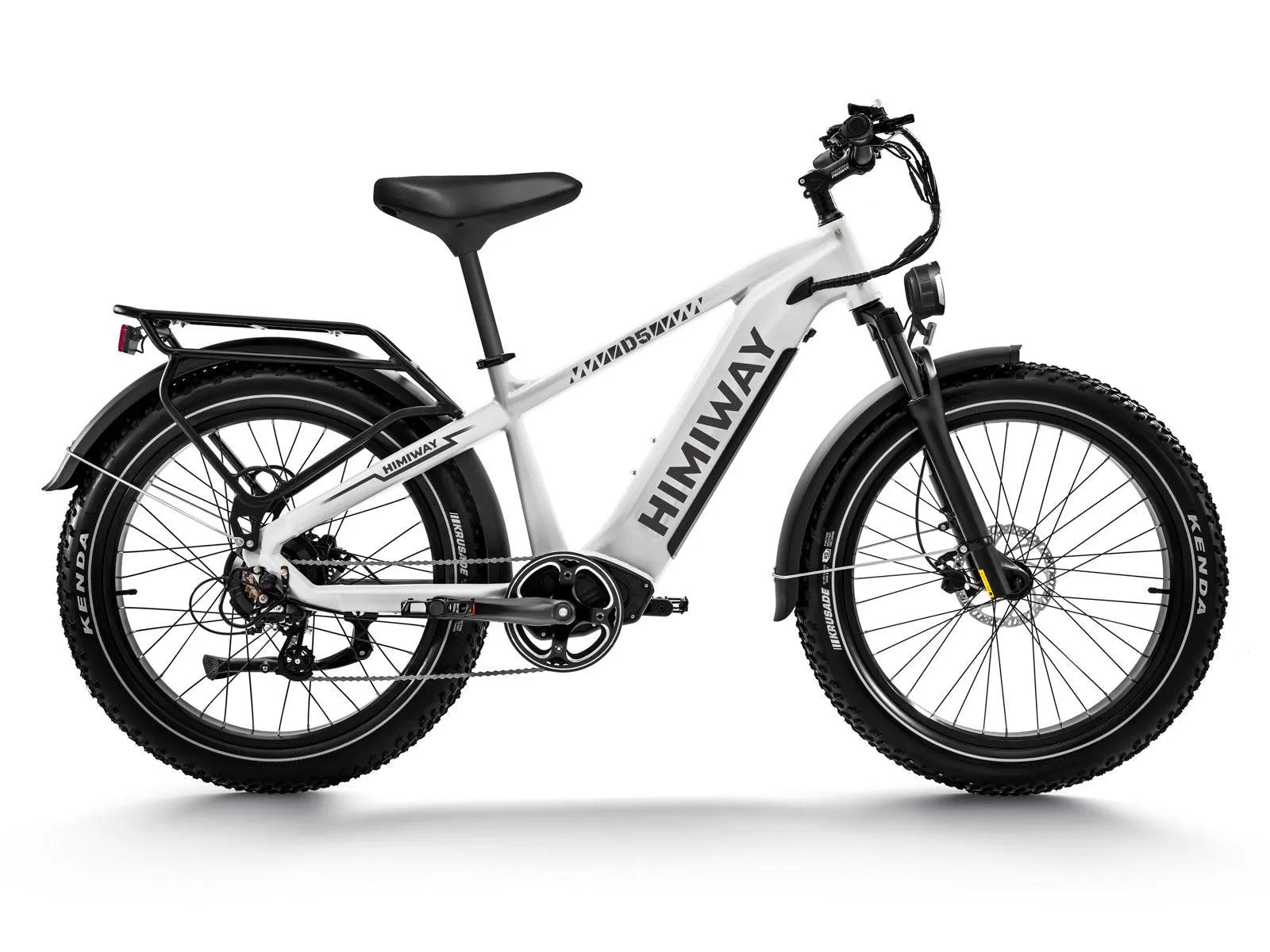
Real Himiway E-Bike Product Images
The gallery uses official Himiway product assets so shoppers can compare the physical design of several models before clicking through.

How to Choose the Best Himiway Electric Bike
Buying an e-bike based only on motor wattage is one of the easiest ways to choose the wrong model. The better approach is to match the bike to your riding environment.
1. Start with your terrain
If you ride almost entirely on smooth pavement, you don't necessarily need the biggest fat tires or the most aggressive suspension. A commuter-oriented Himiway such as the A7 can make more sense.
If you regularly ride gravel, dirt, grass, rough pavement or campground roads, a fat-tire platform such as the Zebra or D5 family becomes much more attractive.
For technical off-road riding, the D7 Pro occupies a completely different category. Its 1000W mid-drive, 160Nm claimed torque, four-bar rear suspension and 26×4.8 super-fat tires are intended for substantially more demanding terrain.
2. Consider your total weight
Your riding weight isn't just your body weight. Consider clothing, backpack, groceries, tools, child equipment, hunting equipment or other cargo.
Himiway offers several models with high payload ratings, making the brand particularly interesting for larger riders and utility users.
3. Decide how important range is
Battery capacity matters because range is not simply a function of motor wattage. A powerful motor can consume more energy when ridden aggressively. A larger battery provides additional energy reserve.
Himiway's 960Wh options are therefore particularly attractive to riders who want long recreational rides or who don't want to recharge constantly.
4. Don't ignore bike weight
A heavy e-bike can feel stable and planted on the road, but that same weight becomes a disadvantage when you have to lift it.
Before buying a large Himiway, think about stairs, apartment storage, vehicle transportation and the weight rating of your bike rack.
Himiway D5 2.0 Review: Best All-Around Choice?
The D5 2.0 is arguably the most balanced option in the current Himiway range for riders who want a serious all-terrain e-bike without immediately moving to the D7 Pro's $4,000 class.
Its 750W geared hub motor is rated at 90Nm of claimed torque, while the bike adds switchable torque and cadence sensing. That flexibility matters because some riders want a natural pedal feel while others prefer consistent assistance.
The full-suspension system is another major advantage. Himiway lists 100mm front and 130mm rear travel on the current D5 2.0.
The bike also gets a 3.5-inch full-color Bluetooth display, thumb throttle, five pedal-assist levels, integrated lighting and hydraulic disc brakes.
Himiway Zebra Review: Best Himiway Value?
The Himiway Zebra is one of the strongest value propositions in the current lineup because it combines a 750W motor with a 960Wh Samsung/LG battery and a 400-lb maximum payload.
Himiway currently lists the Zebra at $1,499 on its U.S. catalog, compared with a displayed $2,299 reference price.
That makes the Zebra particularly interesting for shoppers who care more about battery capacity and all-terrain capability than about having the newest full-suspension platform.
It uses 26×4 Kenda tires and a torque sensor. The combination creates a stable, planted ride that suits mixed surfaces.
The main reason to choose the D5 2.0 instead would be the newer full-suspension architecture, more advanced display system and broader comfort-focused feature set.
Himiway A7 Review: Best Himiway for Commuting?
If your riding is primarily urban, the A7 deserves attention. Himiway describes it as a full-suspension commuter e-bike with comfort as a central focus.
The current product page lists torque/cadence riding modes, five assist levels and up to 70 miles per charge.
Compared with the fat-tire D5 and Zebra, the A7's road-oriented design makes more sense for someone who spends most of the week commuting on pavement.
It can still provide suspension comfort without requiring the aggressive fat-tire appearance and rolling characteristics of the all-terrain models.
Himiway C3 Cargo eBike Review
Cargo riding requires a different approach. A bike that is excellent for recreational riding isn't automatically ideal for carrying groceries, equipment or passengers.
The C3 is built around utility. Himiway's current product page lists a 750W motor, 960Wh Samsung/LG battery, seven-speed Shimano Altus drivetrain, hydraulic brakes and a maximum payload figure of up to 440 lb for the applicable configuration.
If you regularly carry substantial cargo, the C3 can make much more sense than buying a standard fat-tire e-bike and attempting to adapt it for utility use.
Himiway D7 Pro Review: Is the $4,000 E-Bike Worth It?
The D7 Pro is the model to look at when budget is less important than off-road performance.
Himiway lists a Bafang 1000W mid-drive motor, 160Nm of claimed torque, a 960Wh Samsung/LG battery, 28 MPH listed top speed and up to 80 miles of pedal-assist range.
It also uses 26×4.8 super-fat tires, four-bar linkage rear suspension, a 150mm inverted front fork and a 10-speed Shimano drivetrain.
Those specifications place it in a much more serious off-road category than the Zebra or basic D5.
The trade-off is price. At $3,999, it is a major purchase. It only makes sense if you will actually use the additional performance.
Himiway E-Bike Watts → HP & Speed Calculator
Enter motor wattage and rider/load weight to see an educational horsepower conversion and an illustrative cruising-speed estimate.
This calculator is educational. Horsepower is calculated using approximately 746 watts per horsepower. Speed is not a manufacturer guarantee and depends on controller settings, battery state, rider input, terrain, wind, tires and local regulations.
How Much Motor Power Do You Need?
Himiway offers everything from smaller commuter-oriented motors to 750W-class geared hubs and a 1000W mid-drive in the D7 Pro.
More power is not automatically better. A commuter who spends most of the day on flat pavement may never benefit from the D7 Pro's additional torque.
On the other hand, a heavier rider climbing steep terrain may appreciate the additional motor capability of a 750W or 1000W platform.
350W–500W
Generally suited to efficient urban riding and riders who don't need maximum hill-climbing performance.
750W
A useful sweet spot for riders who want strong acceleration, hills and mixed-terrain capability. Several of Himiway's most popular models use 750W platforms.
1000W+
Best reserved for riders who genuinely need additional performance, especially for challenging off-road terrain. The D7 Pro uses a 1000W mid-drive with 160Nm of claimed torque.
Himiway Battery Size and Real-World Range
Battery capacity is one of the most important specifications when comparing electric bikes.
A 48V 20Ah battery provides approximately 960Wh of nominal energy. That's why models such as the Zebra, D5 Pro, C3 and D7 Pro are interesting for riders who want long-distance capability.
However, advertised range should never be treated as guaranteed mileage. Manufacturers typically measure range under specific test conditions.
What reduces Himiway e-bike range?
- High rider and cargo weight
- High riding speeds
- Strong headwinds
- Long or steep climbs
- Low tire pressure
- Cold temperatures
- Heavy throttle use
- Frequent acceleration
For maximum range, maintain correct tire pressure, use sensible assist levels and avoid planning a trip around the absolute maximum advertised range.
Himiway Fat-Tire E-Bike vs Commuter E-Bike
| Priority | Himiway Fat-Tire | Himiway Commuter |
|---|---|---|
| Smooth pavement | Excellent | Excellent |
| Gravel | Excellent | Good |
| Sand / loose terrain | Better | Limited |
| Maneuverability | Good | Better |
| Portability | Usually lower | Usually better |
| Stability | Excellent | Good |
| Long recreational rides | Excellent | Excellent |
Are Himiway E-Bikes Good for Heavy Riders?
Himiway is particularly interesting for larger riders because several models have high payload capacities.
The Zebra, for example, is listed at 400 lb maximum payload. The D5 family also emphasizes high payload capability, while the C3 cargo platform is designed around utility.
But payload capacity should not be confused with identical performance. As total weight increases, acceleration, braking distance, climbing ability and range can all change.
Larger riders should also pay attention to frame geometry, seat height, handlebar position and tire pressure rather than simply searching for the biggest motor.
Are Himiway E-Bikes Good for Commuting?
Yes, but the best Himiway commuter depends on your route.
If your commute is almost entirely smooth pavement, the A7's commuter-focused configuration is worth examining.
If the commute includes rough roads, gravel or poor pavement, the D5 2.0's full suspension and fat tires can provide additional comfort.
If you regularly carry groceries, equipment or other cargo, the C3 is the more logical starting point.
Always consider storage and transportation. A large e-bike may be wonderful to ride but inconvenient to carry upstairs every evening.
Himiway E-Bike Pros and Cons
✓ What We Like
- Broad model selection
- Strong 750W options
- Large 960Wh battery options
- High-payload models
- Full-suspension options
- Fat-tire all-terrain choices
- Cargo-bike options
- Premium mid-drive D7 Pro
- Hydraulic braking on many higher-spec models
- Strong value during promotions
△ What to Consider
- Many Himiway models are heavy
- Fat tires add rolling resistance
- Larger bikes need more storage space
- High-end models can approach $4,000
- Advertised range varies in real-world riding
- Local e-bike laws differ
- Heavy e-bikes require appropriately rated vehicle racks
How Much Does a Himiway E-Bike Cost?
One reason Himiway is worth considering is the breadth of its pricing. Current catalog pricing includes value-oriented models around $1,499, mid-range models around $1,899–$1,999 and premium models approaching $4,000.
That means you don't have to choose between a basic entry-level bike and an ultra-premium mountain e-bike. There are several steps between those extremes.
| Budget | What to Look For | Himiway Examples |
|---|---|---|
| Around $1,500 | Strong value, large battery | Zebra, C3 |
| Around $1,900–$2,000 | More advanced systems | D5 2.0, D5 Pro, A7 |
| Around $2,500 | More specialized capability | D7 |
| Around $4,000 | Premium off-road performance | D7 Pro |
Continue Your E-Bike Research
Build a complete e-bike shortlist by comparing related categories on RenovoMotors.
Himiway E-Bike Buying Checklist
Before clicking Buy, answer these questions:
- Where will I ride most of the time?
- Do I need fat tires?
- Do I need full suspension?
- How much battery capacity do I actually need?
- What is my rider + cargo weight?
- Do I have stairs or difficult storage?
- Does my vehicle rack support the bike's weight?
- What speed class is legal where I live?
- Do I need a throttle?
- Would a mid-drive or hub motor better suit my terrain?
Answering those questions will usually narrow the Himiway lineup down to one or two models very quickly.
Himiway E-Bike FAQ
Are Himiway e-bikes good?
Himiway offers a broad range of e-bikes covering commuting, cargo, fat-tire all-terrain riding and premium mountain riding. The best model depends on your terrain, payload, desired range and budget.
What is the best Himiway e-bike?
For many buyers, the D5 2.0 is the best overall starting point because it combines 750W power, full suspension, torque/cadence riding modes and all-terrain capability. The Zebra is a strong value alternative, while the D7 Pro is the premium off-road choice.
Which Himiway has the longest range?
Several current Himiway models advertise up to around 80 miles, including the Zebra, D5 Pro, C3 and D7 Pro. Actual range varies significantly based on rider weight, terrain, speed, wind, temperature, tire pressure and riding mode.
Is Himiway good for heavy riders?
Yes. Several Himiway models are designed around high payload capacities, including models rated around 400 lb or higher. Always verify the specific model's current payload specification before purchase.
Is Himiway a good brand for long-distance riding?
Himiway offers several large-battery models, including 960Wh platforms, which are attractive for longer recreational trips. Advertised range is not guaranteed and should be adjusted for real riding conditions.
Which Himiway is best for commuting?
The A7 is one of the most commuter-focused options in the lineup. Riders who commute over rough roads may prefer a D5 2.0 because of its all-terrain design and full suspension.
Which Himiway is best for off-road riding?
The D7 Pro is the premium off-road choice, with a 1000W mid-drive, 160Nm claimed torque, 26×4.8 super-fat tires and advanced suspension. For less demanding mixed terrain, the D5 family and Zebra can be more cost-effective.
Is the Himiway D5 better than the Zebra?
The D5 2.0 is the more advanced comfort-focused platform, especially because of its full suspension and newer electronics. The Zebra can be the better value if your priority is a 960Wh battery, 750W motor and high payload at a lower displayed price.
Are Himiway e-bikes heavy?
Many Himiway models are substantial bikes because they use large batteries, suspension, fat tires and high-capacity frames. Buyers should consider storage and transportation before choosing a large model.
Are Himiway e-bike promotions worth waiting for?
Himiway frequently runs promotional campaigns and bundle offers. Because pricing and promotions can change, compare the current live catalog rather than assuming a previous sale price will remain available.
Ready to Find Your Himiway E-Bike?
Whether you want a long-range Zebra, comfortable D5 2.0, commuter-focused A7, practical C3 Cargo or premium D7 Pro, the best move is to compare the current configurations and promotional pricing before ordering.