

Himiway E Bike Reviews: Best Models & Buying Guide
Himiway E Bike Reviews: Best Models, Specs & Buying Guide
Looking for a Himiway electric bike but not sure which model makes sense? We compare the D5 2.0, D5 Pro, A7 and D7 Pro across power, range, suspension, comfort, price and intended use so you can narrow down the right bike before spending $2,000 or more.
Quick Answer: Which Himiway E Bike Should You Look At?
There isn't one Himiway e-bike that is perfect for every rider. The current lineup covers commuter-focused bikes, full-suspension fat-tire models and high-performance mid-drive mountain bikes.
- D5 Pro: A strong choice if you want a 500W mid-drive, 960Wh battery and an all-terrain setup without moving all the way to the $4,000 D7 Pro.
- D5 2.0: A versatile full-suspension option with a 750W geared hub motor, 90Nm torque and a comfortable fat-tire setup.
- A7: Better suited to riders prioritizing comfortable everyday commuting and a step-through-style urban experience.
- D7 Pro: The performance-oriented choice for riders who specifically want a 1000W mid-drive, 960Wh battery, 28 mph top speed and serious off-road hardware.
Himiway E Bike Reviews: Our Featured Models
The models below cover the main reasons buyers search for Himiway e bike reviews: long range, fat tires, suspension, commuter comfort and high-performance mountain-bike capability.

Himiway D5 Pro
- 500W mid-drive motor
- 960Wh Samsung/LG battery
- Up to 80 miles advertised max range
- 20+ mph listed top speed
- 26 x 4.0-inch fat tires
- Hydraulic disc braking system
Why consider it? The D5 Pro sits in an interesting part of the lineup: substantially more premium than an entry-level hub-motor bike while remaining below the flagship D7 Pro's current listed price.
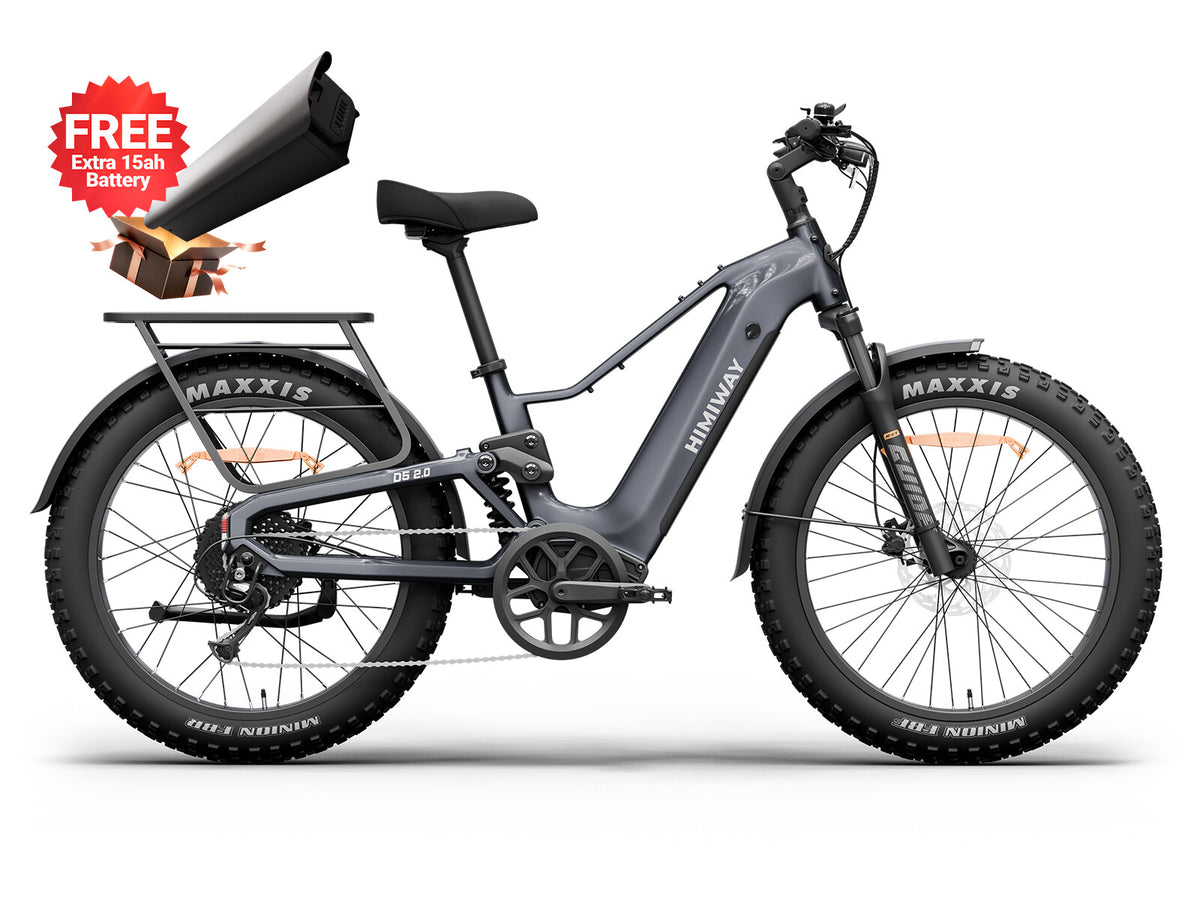
Himiway D5 2.0
- 750W geared hub motor
- 90Nm torque
- Full front and rear suspension
- Torque/cadence sensor switching
- 440 lb listed payload capacity
- Multiple frame and color configurations
Why consider it? The D5 2.0 is aimed at buyers who want comfort and versatility. Its suspension and fat tires make it particularly interesting for riders who regularly move between pavement, gravel and rougher roads.

Himiway A7
- Full-suspension commuter design
- Up to 70 miles listed range
- Torque/cadence riding experience
- Integrated commuter-oriented equipment
- Available in multiple colors
- Designed around everyday comfort
Why consider it? If your priority is a comfortable everyday bike rather than extreme trail performance, the A7 deserves attention. It is positioned around smooth commuting and comfort rather than maximum motor output.

Himiway D7 Pro
- 1000W mid-drive motor
- 160Nm listed torque
- 960Wh Samsung/LG battery
- 28 mph listed top speed
- Up to 80 miles advertised range
- 26 x 4.8-inch super-fat tires
Why consider it? The D7 Pro is a different category of machine from the commuter-focused models. It is built around high torque, suspension, traction and off-road performance, making its higher price easier to understand when those features are actually important to the rider.
Why Himiway E Bikes Get So Much Attention
The biggest reason Himiway appears repeatedly in searches for long-range electric bikes is that its lineup is not built around a single type of rider. Instead, the brand offers several distinct configurations, including fat-tire bikes, full-suspension models, commuter bikes and mid-drive mountain e-bikes.
That matters because buying an e-bike based only on motor wattage can be misleading. A 750W hub motor and a 500W mid-drive motor can produce very different riding experiences. Battery capacity, torque, sensor type, gearing, tire size, suspension and rider weight all influence how a bike actually feels.
Himiway E Bike Comparison
Use this table as the fastest way to narrow down the lineup. Specifications and prices are based on the current Himiway listings checked for this article.
| Model | Motor | Battery | Advertised Range | Top Speed | Current Listed Price | Best For |
|---|---|---|---|---|---|---|
| D5 Pro | 500W Mid-Drive | 960Wh | Up to 80 mi | 20+ mph | $1,899 | All-terrain riders |
| D5 2.0 | 750W Hub | 15Ah | Up to 70 mi PAS | Adjustable | $1,999 | Comfort + mixed terrain |
| A7 | Hub Motor | — | Up to 70 mi | — | $1,999 | Commuting |
| D7 Pro | 1000W Mid-Drive | 960Wh | Up to 80 mi | 28 mph | $3,999 | Serious off-road |
| Model | Rating | Suspension | Tire Style | Drive System | CTA |
|---|---|---|---|---|---|
| D5 Pro | ★★★★★ 4.7/5 | Front suspension | 26 x 4.0 | Mid-drive | View Deal |
| D5 2.0 | ★★★★★ 4.9/5 | Full suspension | 26 x 4.0 | Geared hub | View Deal |
| A7 | ★★★★★ 4.9/5 | Full suspension | Commuter | Hub | View Deal |
| D7 Pro | ★★★★★ 4.9/5 | Advanced full suspension | 26 x 4.8 | Mid-drive | View Deal |
Electric Bike Power Calculator
Enter a motor wattage to estimate horsepower and get a broad speed category. Horsepower is a direct mathematical conversion; speed is only an approximation because real-world e-bike speed depends on gearing, controller limits, rider weight, terrain, battery voltage, tires and local regulations.
How to Choose the Right Himiway E Bike
Searching for “Himiway e bike reviews” usually means you have already narrowed your choices to electric bikes but need help deciding which configuration actually fits your riding. That decision should start with your use case rather than the largest motor number printed on the product page.
Think about where you will ride. A person commuting primarily on paved streets has different requirements from someone riding forest trails, sand, snow or rocky terrain. Likewise, a rider who wants to carry equipment or spend several hours on the bike may value battery capacity and suspension more than a commuter who only rides five or ten miles each way.
1. Motor Type Matters
Himiway's current lineup includes both hub-motor and mid-drive designs. A hub motor places the motor in a wheel, while a mid-drive motor is positioned around the bicycle's crank area.
Mid-drive systems can provide a more bicycle-like power delivery because the motor works through the drivetrain. They can also be particularly useful on hills because gearing becomes part of the power system. Hub motors, meanwhile, can offer a straightforward riding experience and can work very well for commuters and general-purpose riding.
This is why comparing a 500W mid-drive directly against a 750W hub motor purely by wattage can produce the wrong conclusion. The D5 Pro and D5 2.0, for example, use different drive architectures.
2. Battery Capacity Is More Important Than a Marketing Range Number
Range is one of the most searched specifications in Himiway e bike reviews, but advertised range should always be treated as a test-condition estimate. Rider weight, hills, wind, temperature, tire pressure, assist level, throttle use and stop-and-go riding can all change the result.
Battery capacity is normally expressed in watt-hours. As a simple example, a 48V battery rated at 15Ah has a nominal energy capacity of approximately 720Wh before accounting for system losses and usable-capacity limits.
This gives buyers a more useful framework than simply asking which bike has the highest claimed range. If you routinely ride long distances, look at battery size, charging requirements and your expected assist level together.
3. Fat Tires: When Are They Actually Useful?
Fat tires are not automatically better for every rider. Their advantage is primarily stability, traction and the ability to run lower tire pressures across certain surfaces.
The D5 Pro uses 26 x 4.0-inch tires, while the D7 Pro uses even wider 26 x 4.8-inch tires. Those dimensions make sense for riders who spend time away from smooth pavement.
For urban riders, however, a narrower commuter tire can feel quicker and more efficient. This is one reason the A7 occupies a different position in the lineup from the D7 Pro.
4. Suspension Can Transform Rough-Road Comfort
Suspension is another major distinction between models. The D5 2.0, for example, is built around a full-suspension platform, while the D7 Pro goes considerably further with its off-road suspension architecture.
Suspension can reduce the amount of shock transferred into the rider when crossing potholes, roots, rocks and rough trails. It also allows the bike to maintain better contact with uneven surfaces.
But suspension adds weight, complexity and cost. If your entire commute is on smooth asphalt, you may not need the same suspension hardware as a rider spending weekends on technical trails.
5. D5 Pro Review: The Interesting Middle Ground
The Himiway D5 Pro is particularly interesting for buyers who want an all-terrain bike but do not necessarily want to spend the D7 Pro's current $3,999 listed price.
Himiway currently lists the D5 Pro at $1,899, down from a displayed regular price of $2,599. Its official product page lists a 500W mid-drive motor, 960Wh Samsung/LG battery, up to 80 miles of advertised maximum range and a 20+ mph top speed. The same page currently displays a 4.7/5 rating.
That combination gives the D5 Pro a particularly compelling specification sheet for someone looking for a long-range all-terrain bike without stepping into the flagship price category.
D5 2.0 Review: Comfort and Versatility
The D5 2.0 takes a different approach. Its current listing shows a 750W, 90Nm geared hub motor and full suspension, along with torque/cadence sensor switching.
For riders who spend significant time on mixed surfaces, this combination can make more sense than buying a bike solely for its maximum speed. Full suspension and wide tires can make rough roads more forgiving, while the larger motor provides plenty of assistance for everyday riding.
Himiway currently lists the D5 2.0 at $1,999 with a displayed regular price of $2,698. The product page also shows a 4.9/5 rating from 164 reviews at the time checked.
A7 Review: A Different Kind of Himiway
The A7 is worth considering if your idea of an ideal e-bike is closer to a comfortable daily commuter than an extreme trail bike.
Himiway describes the A7 as a full-suspension commuter eBike and currently lists up to 70 miles per charge. Its product page shows a 4.9/5 rating from 49 reviews at the time checked.
The practical advantage of this type of design is that it does not force every rider into a huge fat-tire mountain bike. If you are mainly riding streets, bike paths and neighborhood roads, commuter-oriented geometry and equipment may be a better fit.
D7 Pro Review: When More Power Makes Sense
The D7 Pro is aimed at a very different buyer. Himiway currently lists a 1000W Bafang mid-drive motor, 160Nm torque, a 960Wh Samsung/LG battery, 28 mph top speed and up to 80 miles of pedal-assist range.
It also uses 26 x 4.8-inch super-fat tires and a much more substantial suspension setup. Himiway lists a 400 lb payload capacity and a 10-speed Shimano drivetrain.
That specification list explains why its current $3,999 price is substantially higher than the D5 Pro or A7. It is not simply a commuter bike with a bigger battery; it is positioned as a high-performance mountain/off-road machine.
Himiway E Bikes: Pros and Things to Consider
What Buyers May Like
- Large battery options on several models
- Multiple riding categories
- Fat-tire and full-suspension choices
- Mid-drive options for performance-focused riders
- Hydraulic braking on several higher-spec models
- Commuter and off-road choices within one brand
- Current promotional pricing on selected models
Things to Consider
- Heavy bikes can be difficult to lift or transport
- Real-world range can be lower than advertised maximum range
- Fat tires can add rolling resistance and weight
- High-performance models cost substantially more
- Local e-bike speed/class laws vary by location
- Always verify current stock and final configuration
Which Himiway E Bike Is Best for Your Riding Style?
For Commuting
Start with the A7 if comfort and everyday usability are your priorities. You may not need a huge off-road tire or extreme motor torque for ordinary urban travel.
For Mixed Terrain
The D5 2.0 makes sense for riders who want suspension, fat tires and substantial motor assistance without moving into the flagship D7 Pro price category.
For Long-Distance All-Terrain Riding
The D5 Pro deserves close attention because its current specification combines a 960Wh battery with a mid-drive motor and 80-mile advertised maximum range.
For Serious Off-Road Riding
The D7 Pro is the model to investigate when high torque, wide tires, advanced suspension and a 1000W mid-drive are central to your requirements.
More Himiway Buying Guides
Build an internal SEO cluster around this page by connecting it to your individual Himiway reviews and model-specific guides.
Himiway E Bike Buying Checklist
Before clicking the purchase button, run through this checklist. It can prevent an expensive mismatch between the bike's specification sheet and the way you actually intend to ride.
- Measure your riding area: pavement, gravel, trails, sand or mixed terrain.
- Check rider height: verify the specific model's size recommendations.
- Check payload: include rider weight plus luggage, accessories and cargo where applicable.
- Compare battery capacity: do not compare range numbers without considering battery size and riding conditions.
- Consider transportation: a heavy fat-tire e-bike may require a suitable vehicle rack or storage solution.
- Check local regulations: speed and e-bike classifications vary by jurisdiction.
- Check current promotion: discounts, free accessories and battery offers can change.
- Confirm stock: verify the exact color, size and battery configuration before checkout.
How Much Real-World Range Can You Expect?
One of the most important points in any Himiway e bike review is that advertised range should not be interpreted as a guaranteed distance.
A rider using maximum throttle on hills with a heavy load can use much more energy than a lighter rider using low pedal-assist on flat pavement. Temperature and tire pressure also influence efficiency.
Therefore, treat an advertised “up to 80 miles” figure as a maximum test-condition reference rather than a promise that every rider will achieve 80 miles.
If range is extremely important, battery capacity is one of the first specifications worth comparing. After that, look at the motor system, terrain and expected assist level.
Are Himiway E Bikes Worth Considering?
The answer depends on what you value. Himiway's current lineup gives buyers access to configurations ranging from commuter-oriented models to large fat-tire full-suspension bikes and powerful mid-drive mountain e-bikes.
That variety is useful because buyers can select the bike around their riding environment rather than trying to force one model to do everything.
For many shoppers, the most important comparison is therefore not “Which Himiway bike has the biggest motor?” but rather “Which Himiway bike gives me the components I will actually use?”
Himiway E Bike Reviews: Frequently Asked Questions
Are Himiway e bikes good for long-distance riding?
Which Himiway e bike has the longest advertised range?
Is the Himiway D5 Pro worth considering?
What is the difference between D5 Pro and D5 2.0?
Is Himiway D7 Pro good for off-road riding?
How fast can a Himiway e bike go?
Are Himiway e bikes heavy?
Does Himiway offer a warranty?
Should I choose a hub motor or mid-drive Himiway?
Do Himiway advertised range figures represent guaranteed mileage?
Ready to Compare Himiway E Bikes?
If you're shopping for a high-value electric bike, compare the motor, battery, suspension, tires, riding position and intended terrain before focusing on the headline price. Himiway's current lineup gives you several distinct options depending on how you plan to ride.
Check Current Himiway Deals → Review Comparison AgainPricing and availability note: Product prices, stock status, ratings, promotions, included accessories and specifications can change. Verify the live retailer page before purchasing. Advertised range is not a guarantee of real-world mileage.