

Himiway eBike Review 2026: Models, Specs & Buying Guide
Himiway eBike Review: Which Himiway Electric Bike Is Right for You?
Looking for a Himiway eBike review that goes beyond marketing claims? We compare the current Himiway lineup, including the D5 2.0, A7 and D7 Pro, so you can quickly understand power, range, comfort, suspension, price and which type of rider each model is designed for.
Affiliate disclosure: RenovoMotors may earn a commission if you purchase through links on this page. This does not increase your purchase price.
Himiway eBike Review: Quick Answer
Himiway's current lineup is aimed at riders who want substantial motor power, large batteries, comfort-oriented frames and enough equipment for commuting, recreational riding and off-road use.
The important point is that there is no single Himiway model that makes sense for every rider. A heavy mountain eBike can be excellent on rough terrain but unnecessary for someone who spends most of the week riding paved roads. Likewise, a comfortable commuter can be a better fit for everyday transportation even when it has less aggressive off-road hardware.
Best Himiway eBikes to Consider
These are the models worth putting on your shortlist before you buy. Prices, promotions and availability can change, so always check the current Himiway product page before placing an order.
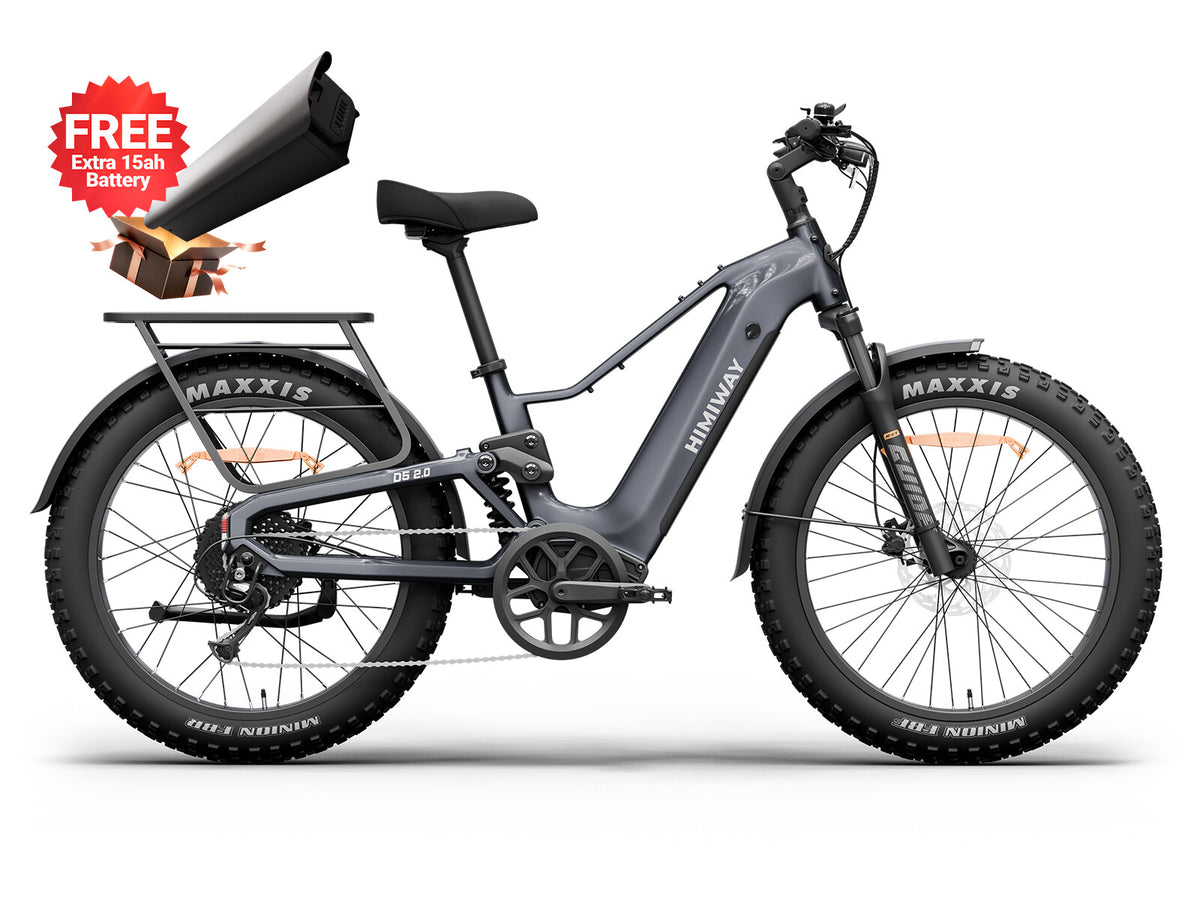
Himiway D5 2.0
- Full suspension with 100mm front / 130mm rear travel
- 26 x 4.0-inch Maxxis tires
- Torque and cadence sensing
- Shimano 8-speed drivetrain
- Large rear rack and commuter-friendly equipment
Current promotion and inventory should be verified before purchase.

Himiway A7
- Full suspension commuter design
- Torque/cadence sensor switching
- Adjustable handlebar position
- Integrated lighting
- Rear rack compatibility

Himiway D7 Pro
- Four-bar linkage rear suspension
- 150mm inverted front fork
- 26 x 4.8-inch CST fat tires
- 10-speed Shimano drivetrain
- Designed for demanding off-road riding
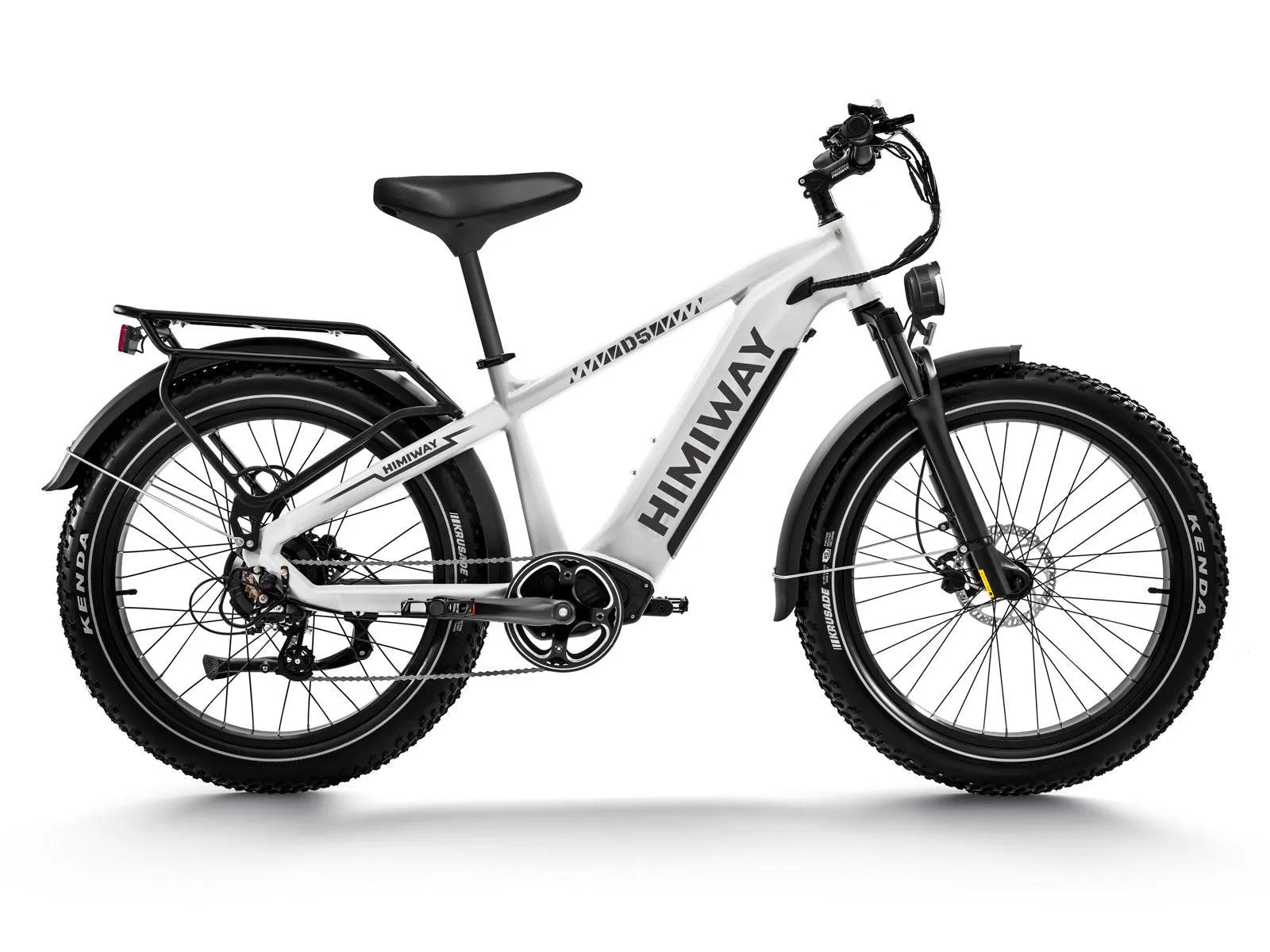
Himiway D5 / Zebra
- All-terrain fat-tire design
- Comfort-focused geometry
- Rear rack included
- Strong option for mixed-surface riding
- Lower current listed price than D5 2.0
Himiway eBike Comparison
The easiest way to narrow down the lineup is to compare the characteristics that actually affect the riding experience: motor type, torque, range, suspension, tire size, weight and intended use.
| Model | Motor | Torque | Advertised Range | Best For | Price* | |
|---|---|---|---|---|---|---|
| D5 2.0 | 750W hub | 90Nm | Up to 70 mi | All-round / fat tire / mixed terrain | $1,999 | View |
| A7 | 750W hub | 70Nm | Up to 70 mi | Commuting / comfort | $1,999 | View |
| D7 Pro | 1000W mid-drive | 160Nm | Up to 80 mi | Hardcore off-road | $3,999 | View |
| D5 / Zebra | 750W hub | — | Up to 80 mi | All-terrain value | $1,499 | View |
*Prices and promotional offers shown above are examples based on the current official Himiway listings checked for this article and can change. Advertised range depends on rider weight, terrain, assist level, temperature, speed and other conditions.
eBike Motor Calculator: Watts → Approximate HP
Motor wattage is useful for comparing electric bikes, but it should not be treated as a direct measurement of road speed. Gearing, controller settings, rider weight, battery voltage, torque and terrain all matter.
This calculator converts watts to horsepower using 746 watts ≈ 1 horsepower. It does not predict actual eBike speed.
Himiway eBike Review: What You Should Know Before Buying
Buying an eBike in the $1,500–$4,000 range is different from buying a basic bicycle. At this price level, you're paying for the motor system, battery capacity, frame design, suspension, drivetrain, brakes, electronics, tires and the overall riding experience.
Himiway has built its lineup around a particular idea: give riders substantial electric assistance and a robust chassis without limiting the product to one narrow riding environment. That is why you'll find commuter-oriented bikes, fat-tire models and much more aggressive mountain bikes in the same brand ecosystem.
The result is a lineup that can look confusing at first. A 750W commuter and a 750W fat-tire eBike may share headline motor numbers while feeling completely different on the road. Likewise, a 1,000W mid-drive mountain bike is not simply a faster version of a commuter bike. It changes how the motor interacts with gearing, hills and technical terrain.
Motor Power: Don't Shop by Watts Alone
One of the biggest mistakes when shopping for an eBike is treating wattage as the only performance metric.
A motor's nominal or advertised wattage doesn't tell the entire story. Torque matters when climbing. Motor placement matters because a mid-drive can use the bicycle's gearing differently from a hub motor. Controller characteristics influence how quickly assistance arrives. Battery voltage and capacity affect the electrical system and potential range.
This is particularly relevant when comparing the Himiway D5 2.0 with the D7 Pro. The D5 2.0 uses a 750W geared hub motor with 90Nm of torque, while the D7 Pro uses a Bafang 1000W mid-drive with substantially higher stated torque. :contentReference[oaicite:2]{index=2}
For everyday riders, the D5 2.0 can therefore make more sense than simply choosing the most powerful model available. If your riding consists of paved roads, bike paths, neighborhood streets and occasional trails, paying considerably more for extreme off-road hardware may not provide proportional benefits.
Range: What Does "Up to" Actually Mean?
Himiway publishes maximum range figures for its bikes, but maximum range should never be interpreted as a guaranteed real-world distance.
Range is affected by rider weight, speed, hills, tire pressure, temperature, wind, surface conditions, cargo, assist level and how much throttle is used. Riding continuously at higher power can reduce range considerably compared with an efficient pedal-assist ride on flat ground.
The D5 2.0, for example, is listed with up to 70 miles of pedal-assist range, while Himiway's D7 Pro is advertised with up to 80 miles. These figures are useful for comparing battery and system positioning, but they should not be treated as a promise that every rider will achieve those numbers. :contentReference[oaicite:3]{index=3}
Ride Comfort and Suspension
Suspension is one of the reasons Himiway's larger bikes appeal to riders who spend time on poor roads and trails.
The D5 2.0 combines front and rear suspension with 26 x 4.0-inch tires. Himiway lists 100mm front and 130mm rear travel, while its specification page also lists Maxxis Minion tires. :contentReference[oaicite:4]{index=4}
The A7 takes a different approach. It is positioned as a commuter-oriented full-suspension eBike and includes an adjustable stem, broad saddle and integrated lighting. Himiway lists the A7 with a 750W motor, 15Ah battery, switchable torque/cadence sensing and up to 70 miles of pedal-assist range. :contentReference[oaicite:5]{index=5}
For a rider who spends most of their time on city streets, this type of comfort-focused configuration can be more relevant than enormous fat tires or extreme mountain suspension.
Fat Tires: Are They Worth It?
Fat tires provide additional air volume and a broad contact patch. They can be useful on loose dirt, gravel, sand and uneven surfaces, although they also contribute to weight and rolling resistance.
The D5 2.0 uses 26 x 4.0-inch tires, while the D7 Pro goes further with 26 x 4.8-inch super-fat tires. :contentReference[oaicite:6]{index=6}
If your normal route is smooth asphalt, you don't necessarily need the biggest tires available. But if your weekends involve dirt trails, rough roads, loose surfaces or mixed terrain, wider tires can become a meaningful part of the riding experience.
Himiway D5 2.0 Review
The D5 2.0 is arguably the easiest model in this comparison to understand. It combines a 750W geared hub motor, 90Nm torque, full suspension, fat tires, a rear rack and a 400-pound stated payload capacity.
Himiway currently lists the D5 2.0 at $1,999 with a previous comparison price of $2,698, although promotional pricing can change. The current page also lists a 2-year warranty, 15-day return policy and free shipping within the stated U.S. coverage area. :contentReference[oaicite:7]{index=7}
One especially interesting feature is the combination of torque and cadence sensing. Riders who like a more natural relationship between pedal input and motor assistance may appreciate torque sensing, while cadence sensing can provide a more straightforward assisted-riding experience.
The D5 2.0 is also substantial. Himiway lists the bike at around 92 pounds in its specifications, so this is not a lightweight bicycle that you'll casually carry upstairs every day. :contentReference[oaicite:8]{index=8}
That weight is the trade-off for the equipment, large tires, suspension, battery and load capacity. For garage storage, RV use or riding directly from home, it may be perfectly manageable. For frequent stair carrying, a lighter model may be more practical.
Himiway A7 Review
The A7 is the more obvious choice for riders whose priority is comfortable everyday transportation.
Himiway lists the A7 with a 750W motor producing 70Nm of torque, a 48V 15Ah battery using Samsung/LG cells, torque/cadence sensor switching and a claimed pedal-assist range of up to 70 miles. :contentReference[oaicite:9]{index=9}
Its geometry is also designed around comfort. The adjustable stem lets riders alter handlebar position, while the large saddle and full-suspension design are aimed at reducing fatigue during longer rides.
Another useful feature is the integrated lighting system. For commuters, small practical details like lighting, rack compatibility and riding posture can be more important than having the biggest possible motor.
If you want an eBike primarily for commuting, errands, neighborhood rides, paved trails and occasional light dirt, the A7 deserves a place on your shortlist.
Himiway D7 Pro Review
The D7 Pro is a completely different proposition. Himiway lists a 1,000W Bafang mid-drive motor, 160Nm of torque, a 960Wh Samsung/LG battery, 26 x 4.8-inch tires, a 10-speed Shimano drivetrain and up to 80 miles of pedal-assist range. :contentReference[oaicite:10]{index=10}
It is designed for riders who actually need that hardware. Himiway describes the D7 Pro around demanding mountain riding, backcountry use, difficult terrain and heavier riders.
The four-bar rear suspension and 150mm inverted front fork are particularly relevant if your routes include rocks, deep ruts and aggressive terrain.
The downside is straightforward: price and size. At a current listed price of $3,999, the D7 Pro is a substantial investment. It is also far more bike than many casual commuters need.
In other words, the D7 Pro should be considered because you need its capabilities—not simply because the specifications look impressive.
Himiway D5 / Zebra Review
The D5, commonly associated with the Zebra name, remains an interesting option for buyers who want an all-terrain fat-tire platform without moving into the price range of the D7 Pro.
Himiway's current listing shows the D5/Zebra at $1,499, with a 750W geared hub motor, 26 x 4-inch tires and an advertised maximum range of up to 80 miles. :contentReference[oaicite:11]{index=11}
It is worth comparing this model directly with the newer D5 2.0 rather than assuming the newer bike is automatically the better purchase for every rider. The newer D5 2.0 brings a more modern suspension and component package, while the older/current D5/Zebra can be attractive when price is the main consideration.
Build Quality and Components
Component specifications are important because an eBike isn't just a motor and battery.
The D5 2.0, for example, uses Shimano 8-speed shifting and Tektro hydraulic disc brakes, while the D7 Pro moves to a 10-speed Shimano drivetrain and four-piston hydraulic braking hardware. :contentReference[oaicite:12]{index=12}
These differences matter when you ride at higher speeds, carry more weight or spend more time on steep terrain.
For everyday riding, however, you should also consider whether replacement parts are readily available, whether there is a local dealer or service option, and how comfortable you are doing basic maintenance yourself.
Who Should Buy a Himiway eBike?
- Riders who want a powerful electric assist system.
- People who enjoy fat-tire or mixed-surface riding.
- Commuters who want a more substantial eBike platform.
- Riders who prioritize comfort and suspension.
- Outdoor riders who regularly tackle dirt, gravel or trails.
- Heavier riders who need a higher stated payload capacity.
Who Might Want Something Else?
- People who need to carry their bike up several flights of stairs.
- Riders looking for an extremely lightweight road eBike.
- People whose riding is almost entirely flat, short-distance commuting.
- Buyers who do not need a high-capacity battery or suspension.
- Riders who need a very compact folding bicycle.
Himiway eBike Pros and Cons
Potential Advantages
- Strong motor options.
- Large battery options.
- Several full-suspension models.
- Fat-tire options for mixed terrain.
- Useful payload capacity on selected bikes.
- Wide range of rider categories.
- Current lineup includes commuter and serious off-road options.
Things to Consider
- Many models are heavy compared with conventional bicycles.
- Large tires can increase rolling resistance.
- Real-world range can be substantially below maximum advertised range.
- High-performance models become expensive quickly.
- Local regulations may restrict how and where certain eBikes can be used.
- Always confirm current specifications before ordering.
How to Choose the Right Himiway eBike
1. Start With Your Main Riding Environment
Think about where 80% of your riding actually happens. If it is city pavement, prioritize comfort, lighting, rack utility, manageable geometry and efficient range. If it is dirt and rough terrain, suspension, tires, torque and braking become much more important.
2. Consider Your Weight and Cargo
Don't only consider your own body weight. Add backpacks, groceries, camping equipment, children or other cargo when relevant. Himiway publishes payload limits for many models, so compare the total expected load with the stated capacity.
3. Decide Whether You Need Full Suspension
Full suspension can dramatically change comfort on poor surfaces, but it also adds complexity and weight. For smooth roads, a simpler bicycle may be enough. For rough trails, the additional suspension hardware can be considerably more valuable.
4. Don't Ignore Bike Weight
A powerful eBike is not necessarily convenient. Consider where you will store it, whether you need to lift it onto a rack and whether you have to move it without motor assistance.
5. Check Local eBike Rules
Regulations differ by country, state and municipality. Before purchasing, check the rules that apply where you intend to ride, especially regarding speed classes, throttles, trails and public-road use.
6. Check the Current Promotion Before Paying
Himiway's current site is displaying a 7th Anniversary promotion, including a free 15Ah battery offer on selected bikes. Promotions and eligibility can change, so check the live product page before assuming a particular bonus is included with your model. :contentReference[oaicite:13]{index=13}
Check Today's Himiway Offers →Himiway eBike Review FAQ
Are Himiway eBikes worth considering?
Himiway is worth considering if you want a relatively powerful eBike with large battery options, fat tires, suspension and multiple riding configurations. The right model depends heavily on your terrain, budget and how much bike weight you are comfortable managing.
What is the best Himiway eBike for commuting?
The A7 is specifically positioned around commuting and comfort, with full suspension, an adjustable stem, integrated lighting and rack compatibility. The D5 2.0 is another option if you want a more all-terrain fat-tire platform.
Which Himiway eBike has the most power?
Among the models compared here, the D7 Pro uses a 1,000W Bafang mid-drive motor and is listed with 160Nm of torque. Himiway positions it toward demanding mountain and off-road riding.
How far can a Himiway eBike go on one charge?
Published maximum range varies by model. Current Himiway listings advertise figures reaching approximately 70–80 miles for several models, but actual range depends on speed, rider weight, terrain, temperature, tire pressure, assist level and other conditions.
Is the Himiway D5 2.0 good for hills?
The D5 2.0 has a listed 750W geared hub motor and 90Nm of torque, plus a multi-speed drivetrain. Those specifications make it a substantial option for hill riding, although actual climbing performance depends on gradient, rider/cargo weight, battery charge and riding mode.
Is Himiway D5 2.0 heavy?
Yes. Himiway's specification page lists the D5 2.0 at approximately 92 pounds. That weight is worth considering if you need to lift the bike regularly.
Does Himiway offer fat-tire eBikes?
Yes. The D5 2.0 uses 26 x 4.0-inch tires, while the D7 Pro uses 26 x 4.8-inch super-fat tires. Himiway also has other fat-tire models in its broader lineup.
What should I check before ordering a Himiway eBike?
Check the exact model, size, current price, promotion eligibility, delivery terms, warranty, return conditions, payload rating, local eBike regulations and whether the bike fits your storage and transport setup.
Does Himiway have a warranty?
Himiway currently advertises a 2-year warranty on its U.S. site for the relevant models, but warranty coverage can vary by product and market. Always review the current warranty terms before purchasing.
Ready to Compare Himiway eBikes?
If you're shopping for a powerful commuter, comfortable fat-tire eBike or serious off-road machine, compare the current Himiway models before making your decision. Prices, colors, inventory and promotional bundles can change.
Shop Himiway eBikes & Check Current Offers →Check the live product page for current pricing, inventory, included accessories and promotional terms.