

Himiway Electric Bikes: Best Models & Buying Guide
Himiway Electric Bikes: Find the Right eBike for Your Ride
Looking for a Himiway electric bike but not sure which model is actually worth your money? We compare Himiway's most important current models, including the D5 2.0, A7 and D7 Pro, so you can choose based on power, range, comfort, terrain and budget.
Why Are Himiway Electric Bikes So Popular?
Himiway has built its lineup around a simple idea: give riders more battery, more comfort and more capability than they typically expect from a conventional commuter eBike.
The result is a range that covers very different riding styles. The D5 2.0 family focuses on all-terrain versatility and full suspension. The A7 targets riders who want a comfortable commuter. The D7 Pro sits at the premium end for riders who want serious mountain-bike performance.
That variety is useful, but it can also make choosing a Himiway electric bike surprisingly difficult. A $1,799 commuter and a nearly $4,000 mountain eBike may both carry the Himiway name while serving completely different purposes.
That's why the best approach isn't simply asking, "What is the best Himiway?" Instead, ask: "Which Himiway gives me the right combination of power, range, comfort and terrain capability?"
Best Himiway Electric Bikes Right Now
These are the models we'd put at the top of the shortlist for different types of buyers. The first model is our main all-around recommendation.
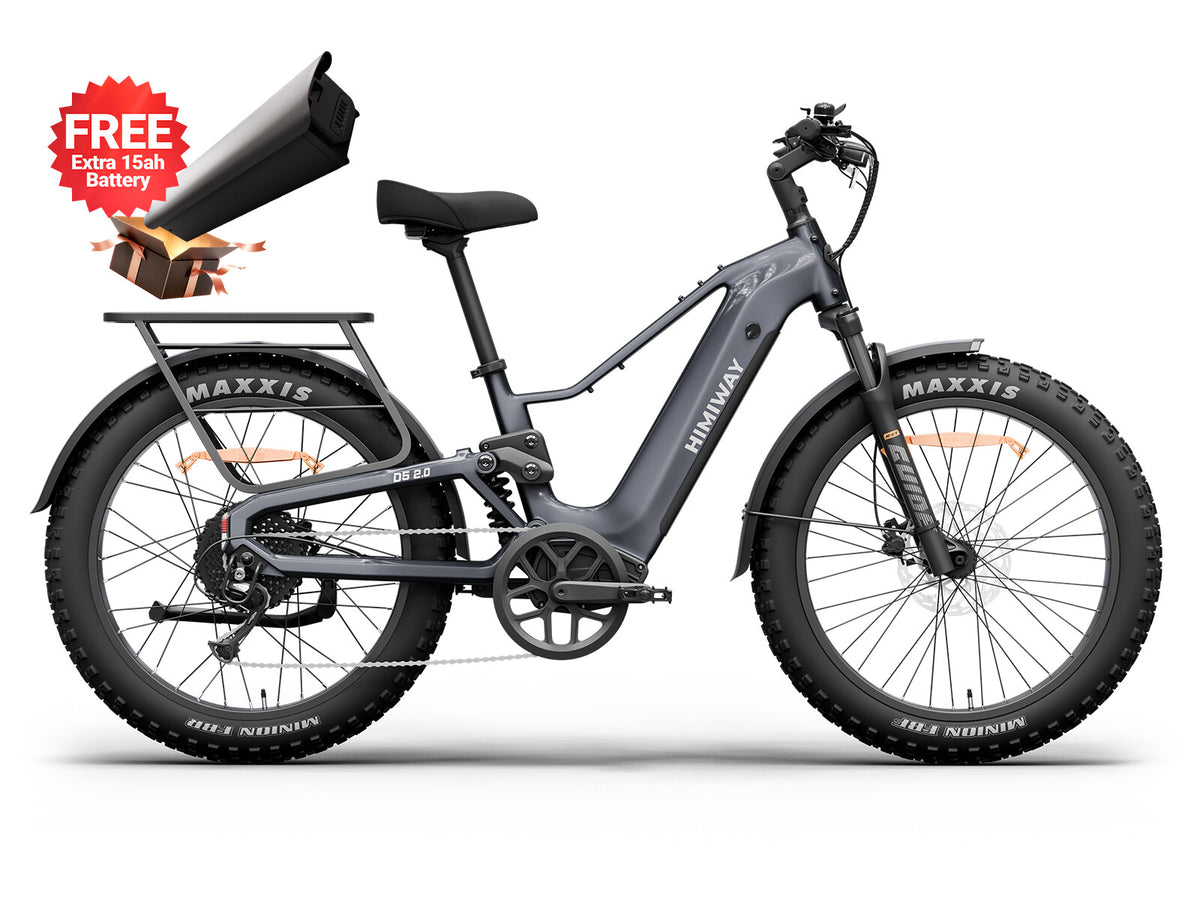
Himiway D5 2.0
The strongest all-around choice for riders who want a full suspension Himiway with high power, large carrying capacity and versatile pavement-to-trail performance.
- 750W / 90Nm geared hub motor
- Full suspension
- Torque + cadence modes
- Up to 60–70+ mile range depending on configuration
- 400-lb payload capacity
- Hydraulic disc brakes
- 26 × 4-inch Maxxis tires

Himiway A7
A more city-focused choice for riders who care about comfort, suspension, everyday utility and a refined commuter setup.
- Full suspension design
- 120mm front suspension
- 90mm rear suspension
- Up to 70 miles listed range
- Torque / cadence riding modes
- MIK-compatible rear rack
- Comfort-focused riding position

Himiway D5 Pro
A compelling choice for riders who prefer a torque-sensing mid-drive system and want strong all-terrain capability.
- 500W mid-drive motor
- Torque sensor
- 130Nm listed torque
- 960Wh Samsung/LG battery
- Up to 80-mile claimed range
- 400-lb payload
- Hydraulic disc brakes

Himiway D7 Pro
The high-ticket choice for serious trail riders who want a powerful mid-drive motor, softail suspension and maximum off-road capability.
- 1000W mid-drive motor
- 160Nm listed torque
- 28 mph listed top speed
- 960Wh Samsung/LG battery
- Up to 80-mile claimed range
- 26 × 4.8 super-fat tires
- 400-lb payload
Quick Answer: Which Himiway Is Best?
For most adult riders, the Himiway D5 2.0 is the best starting point. It combines a 750W motor, full suspension, fat tires, high payload capacity and multiple riding modes without jumping to the $4,000 price territory of the D7 Pro.
If your riding is primarily urban commuting, the A7 makes more sense. If you specifically want a torque-sensing mid-drive, look closely at the D5 Pro. If you are an aggressive off-road rider and budget is less important than performance, the D7 Pro is the premium option.
See Current Himiway Deals →Himiway Electric Bike Specs at a Glance
*Maximum range is a manufacturer claim and actual range can vary substantially according to rider weight, terrain, wind, temperature, tire pressure, assist level and throttle use.
Himiway Electric Bike Comparison
This table makes it easier to see where the major models fit before you click through to the live Himiway store.
| Feature | D5 2.0 | A7 | D5 Pro | D7 Pro |
|---|---|---|---|---|
| Best for | All-around | Commuting | Mid-drive all-terrain | Serious off-road |
| Motor | 750W hub | Commuter-focused | 500W mid-drive | 1000W mid-drive |
| Torque | 90Nm | Model dependent | 130Nm listed | 160Nm listed |
| Battery | Large battery options | 48V platform | 960Wh | 960Wh |
| Range | 60–70+ mi* | Up to 70 mi* | Up to 80 mi* | Up to 80 mi* |
| Suspension | Full suspension | Full suspension | Front suspension | Softail + front suspension |
| Fat tires | 26 × 4.0 | Commuter tires | 26 × 4.0 | 26 × 4.8 |
| Payload | 400 lb | Model dependent | 400 lb | 400 lb |
| Price* | $1,999 | $1,799 | $1,899 | $3,999 |
| Shop | View D5 → | View A7 → | View D5 Pro → | View D7 → |
How to Choose the Best Himiway Electric Bike
Buying a Himiway shouldn't start with the motor number. A 1000W bike isn't automatically better for every rider. The right model depends on how and where you actually ride.
1. Start With Your Terrain
If your typical route is smooth pavement, bike paths and city streets, a commuter-oriented model such as the A7 may be more appropriate than a giant fat-tire mountain bike.
If you regularly encounter potholes, gravel, dirt roads or rough surfaces, full suspension becomes much more valuable.
For serious trail riding, the D7 Pro moves into another category. Its 1000W mid-drive system, large tires and softail suspension are designed around riders who prioritize off-road capability.
2. Think About Battery Size
Battery capacity is one of the most important specifications on an electric bike.
A larger battery generally gives you more energy available for longer rides, but range isn't determined by battery capacity alone.
Rider weight, terrain, wind, temperature, tire pressure, acceleration and assist level can all have a significant effect.
That's why we recommend treating manufacturer range figures as a reference point rather than a guarantee.
3. Hub Motor vs Mid-Drive
Hub motors place the motor inside a wheel hub. They are popular because they can provide strong acceleration and a relatively straightforward drivetrain.
Mid-drive motors sit around the crank area and use the bike's gearing. This can produce a more natural riding feel and can be particularly effective when climbing steep terrain.
The D5 2.0 uses a geared hub platform, while the D5 Pro and D7 Pro demonstrate Himiway's mid-drive approach.
4. Consider Your Weight and Cargo
One of Himiway's strongest selling points is its high-capacity frames. Several current models list a 400-pound maximum payload.
This is particularly useful for heavier riders, people carrying groceries or commuters using racks and panniers.
Remember that payload means the combined supported load according to the manufacturer's specification. Don't automatically interpret it as rider weight alone.
5. Decide How Important Suspension Is
Suspension can dramatically change the feel of a heavier electric bike. It absorbs impacts from potholes, broken pavement and uneven terrain.
For a rider who spends nearly all of their time on perfectly smooth roads, suspension may be less important.
For mixed terrain, however, it can be one of the best comfort upgrades you can buy.
Himiway Motor Power Calculator
Use this calculator to convert motor wattage into approximate horsepower and see an illustrative speed estimate. The speed figure is only a mathematical comparison — actual eBike speed depends on gearing, controller limits, battery voltage, rider weight, terrain, aerodynamics and local regulations.
Himiway D5 2.0: The Best All-Around Choice?
The D5 2.0 is where Himiway's current lineup becomes especially interesting for mainstream buyers.
It isn't the cheapest bike in the catalog, but it also isn't trying to compete solely on price. Instead, it combines full suspension, a powerful 750W geared hub motor, fat tires, high payload capacity and multiple sensor modes.
The current D5 2.0 specification lists a 750W motor producing 90Nm, a 48V 15Ah battery with Samsung/LG 21700 cells, a full-color Bluetooth display, switchable torque/cadence sensing and hydraulic disc brakes. Himiway lists a default 20 mph speed setting with an adjustable range up to 28 mph depending on configuration/class settings. :contentReference[oaicite:1]{index=1}
That combination makes the D5 2.0 a particularly compelling choice for riders who want one bike capable of handling commuting during the week and recreational riding on weekends.
Why the D5 2.0 Is Our Main Recommendation
The biggest advantage is balance.
You don't have to spend nearly $4,000 to get into a high-performance Himiway. At the same time, you aren't buying a basic lightweight commuter that may feel under-equipped once you leave smooth pavement.
The D5 2.0 sits in the middle of the lineup where its combination of performance and utility makes the most sense for a broad audience.
Full Suspension
Himiway lists 100mm front and 130mm rear suspension travel for the standard D5 2.0. :contentReference[oaicite:2]{index=2}
That's meaningful if your daily route includes broken roads, potholes, gravel or uneven trails.
Torque and Cadence Modes
Another important feature is the ability to switch between torque and cadence sensing.
Torque sensing can provide a more natural relationship between your pedaling effort and motor assistance. Cadence sensing can feel more straightforward for riders who simply want the motor to provide assistance once the pedals are turning.
Large Rider Capacity
The D5 2.0 is also designed with heavier riders in mind. Himiway lists a 400-pound bike load capacity for the current model. :contentReference[oaicite:3]{index=3}
That makes it considerably more interesting for riders who find many lightweight commuter eBikes too restrictive.
Himiway A7: Best Himiway for Commuting?
The A7 takes a different approach from the D5 family.
Instead of emphasizing giant fat tires and aggressive all-terrain styling, the A7 is positioned as a premium commuter eBike with full suspension and everyday utility.
Himiway's current A7 page lists a 120mm hydraulic front fork and 90mm rear suspension, plus an adjustable stem and MIK-compatible rear rack. :contentReference[oaicite:4]{index=4}
Those features matter if your electric bike is primarily a transportation tool rather than a weekend trail machine.
Who Should Buy the A7?
- Daily commuters
- Urban riders
- People who prioritize comfort
- Riders carrying groceries or bags
- People who want full suspension without an extreme mountain-bike setup
- Riders who spend most of their time on pavement
Himiway D5 Pro: The Mid-Drive Alternative
The D5 Pro is one of the most interesting choices in the lineup because it changes the motor philosophy completely.
Instead of the D5 2.0's geared hub motor, the D5 Pro uses a 500W mid-drive motor paired with a torque sensor.
Himiway currently lists 130Nm of torque, a 960Wh Samsung/LG battery, up to 80 miles of range and a 400-pound payload capacity. :contentReference[oaicite:5]{index=5}
A mid-drive can be particularly appealing for riders who enjoy actually pedaling the bike and want the motor's assistance to work naturally with the bicycle's gearing.
D5 Pro vs D5 2.0
If you want straightforward electric assistance and a full-suspension fat-tire platform, the D5 2.0 remains extremely compelling.
If you want a more traditional bicycle-like pedaling experience with the benefits of a torque-sensing mid-drive, the D5 Pro deserves the upgrade consideration.
Himiway D7 Pro: Is the $4,000 Upgrade Worth It?
The D7 Pro is the model for riders who don't want to compromise on off-road performance.
Himiway currently lists a 1000W mid-drive motor, 160Nm of torque, 28 mph top speed, 960Wh Samsung/LG battery, up to 80 miles of claimed range and 26 × 4.8-inch super-fat tires. :contentReference[oaicite:6]{index=6}
Himiway describes the D7 Pro as a high-performance softail mountain eBike intended for demanding off-road riding. :contentReference[oaicite:7]{index=7}
Why the D7 Pro Costs More
The price difference isn't simply about a larger motor.
You're paying for a substantially more specialized platform with a mid-drive motor, softail suspension, huge tires, high torque and components aimed at demanding terrain.
For a rider who spends 95% of their time commuting, those upgrades may not make financial sense.
For someone who regularly rides mountain trails, sand, snow or rough backcountry terrain, the additional capability can be much easier to justify.
Himiway Electric Bike Pros & Cons
✓ What We Like
- Large battery options
- Strong motors
- High payload capacities
- Full-suspension models
- Fat-tire all-terrain options
- Mid-drive options
- Wide model selection
- Premium D7 Pro option
- Useful commuter-focused A7
⚠ What to Consider
- Many models are heavy
- Large fat tires add rolling resistance
- Premium models become expensive quickly
- Maximum range isn't typical real-world range
- Local eBike laws vary
- Large bikes require adequate storage
- Off-road models can be overkill for city-only riders
How Much Himiway Range Do You Really Need?
Range is one of the biggest reasons people shop Himiway in the first place. But maximum range shouldn't be the only number you consider.
Suppose your commute is 10 miles each way. A 20-mile daily round trip is very different from someone planning a 50-mile weekend ride.
If you have charging access at work, your requirements are different again.
For Short Commuting
A smaller battery can be perfectly adequate if you're riding a few miles each day and charging regularly.
For Long Commutes
A larger battery gives you more flexibility and reduces range anxiety.
For Recreational Riding
This is where Himiway's larger battery models become especially appealing. Long rides can consume substantially more energy because riders tend to use higher assist levels and encounter hills, acceleration and changing terrain.
What Does 750W Mean on a Himiway eBike?
Motor wattage is essentially an indication of electrical power, but it should never be used as the only measure of an eBike's performance.
Torque, controller output, battery voltage, gearing, motor efficiency, rider weight and terrain all matter.
That's why a well-designed 500W mid-drive can sometimes feel more capable on a steep hill than a larger-rated hub motor.
The D5 2.0's 750W/90Nm configuration is a good example of Himiway targeting riders who want strong acceleration and all-around utility, while the D7 Pro moves to a 1000W mid-drive and 160Nm torque for a much more aggressive off-road application.
Himiway eBike Safety and Legal Considerations
Before buying any high-powered electric bike, check the laws where you live.
eBike classification, maximum assisted speed, throttle rules, trail access, helmet requirements and age restrictions can vary by jurisdiction.
Himiway's current product information lists different class and speed configurations across its lineup, so don't assume that the same legal classification applies to every model or setting.
Always wear an appropriate helmet and use lights and reflective equipment when conditions require them.
Himiway Electric Bike Photo Gallery
Product images below are linked directly from Himiway's current CDN so visitors can see the bikes before clicking through to the offer.


More Electric Bike Guides
Build topical authority around the Himiway article by connecting it to related electric-bike buying guides on your store.
Himiway Buying Checklist
Before spending $2,000 or more on a Himiway electric bike, run through this checklist.
- Choose the terrain first. Decide whether you'll primarily ride pavement, gravel, trails or difficult off-road terrain.
- Calculate your daily distance. Don't pay for enormous battery capacity if your actual riding is only a few miles.
- Check rider and cargo weight. Make sure the selected model's payload specification is appropriate.
- Measure storage space. Himiway's larger bikes are substantial machines.
- Decide between hub and mid-drive. This can have a bigger effect on riding feel than simply comparing wattage.
- Check the current promotion. Himiway regularly changes promotions, bundles and battery offers.
- Check local regulations. Speed and class settings may have legal implications.
- Budget for accessories. A lock, helmet, lights, rack or panniers can materially improve everyday usability.
Check Himiway's Current Promotion Before Buying
Himiway is currently promoting its 7th Anniversary campaign, with the live store showing selected-bike offers and a free 15Ah battery promotion with an advertised September 30 end date. :contentReference[oaicite:8]{index=8}
Because promotions, inventory and qualifying models can change, it's worth checking the live Himiway collection immediately before purchasing rather than relying on an old sale price.
Check Current Himiway Offers →Himiway Electric Bike FAQ
Is Himiway a good electric bike brand?
Himiway has a broad electric-bike lineup covering commuters, fat-tire all-terrain bikes, cargo-oriented models and high-performance mountain eBikes. The best model depends on the rider's terrain, budget, desired range and preferred motor system.
Which Himiway electric bike is best?
For a broad range of adult riders, the D5 2.0 is one of the most balanced choices because it combines a powerful motor, full suspension, fat tires and high payload capacity. The A7 is better suited to commuting, while the D7 Pro targets serious off-road riders.
How much does a Himiway electric bike cost?
Current Himiway prices vary considerably by model. The lineup currently includes models around the $1,800–$2,000 range as well as premium models such as the D7 Pro at approximately $3,999. Promotions can change these prices.
How far can a Himiway eBike go?
Depending on the model, Himiway lists maximum ranges reaching approximately 70–80 miles on some bikes. Actual range can be much lower or higher depending on rider weight, terrain, speed, temperature, wind, tire pressure and assist level.
Is Himiway good for heavy riders?
Several Himiway models are designed with relatively high payload capacities. The D5 2.0, D5 Pro and D7 Pro are examples of models with 400-pound listed capacities in current specifications.
Is Himiway D5 2.0 worth buying?
The D5 2.0 is particularly compelling for riders who want a versatile full-suspension eBike rather than a lightweight city commuter. Its 750W/90Nm motor, full suspension, large tires, high payload capacity and hydraulic brakes make it a strong all-around option.
Is Himiway D7 Pro worth the higher price?
The D7 Pro is aimed at a very different buyer. Its 1000W mid-drive motor, high torque, softail suspension and 26 × 4.8-inch tires make it considerably more specialized for demanding terrain. For normal commuting, the extra cost may not be necessary.
Is a Himiway fat tire eBike good for commuting?
It can be, especially if your commute includes rough pavement, potholes or mixed surfaces. However, fat tires and large frames generally add weight and rolling resistance compared with a lightweight urban commuter.
Does Himiway offer full-suspension electric bikes?
Yes. The current lineup includes multiple full-suspension models, including the D5 2.0 and A7, while the D7 Pro takes suspension performance further for mountain riding.
Where can I check the latest Himiway prices and deals?
The best place to verify current prices, available colors, configurations and promotions is the live Himiway electric-bike collection.
View Himiway Electric Bikes →Find Your Himiway Before the Current Offer Changes
Whether you need a comfortable commuter, an all-terrain fat-tire eBike or a serious mountain machine, Himiway has multiple platforms worth comparing.
For most riders, start with the D5 2.0. Move toward the A7 if commuting is your priority, the D5 Pro if you want a mid-drive, and the D7 Pro if serious off-road performance justifies the premium.
Shop Himiway Electric Bikes → Compare Models Again